Ironcrest Outpost

A fortified Ashborn mining settlement and trade landmark in western Keynew, Ironcrest Outpost guards some of the region’s richest metal-bearing tunnels. Generations of Ashborn miners, smiths, engineers, and wardens have made the outpost their permanent home and the primary transfer point for raw ore moving toward the cities and forges of Keynew.

Ironcrest Outpost, an Ashborn mining settlement in Keynew
Ironcrest at a GlanceAshborn Mining Outpost of Keynew

The Iron Gate of Western Keynew

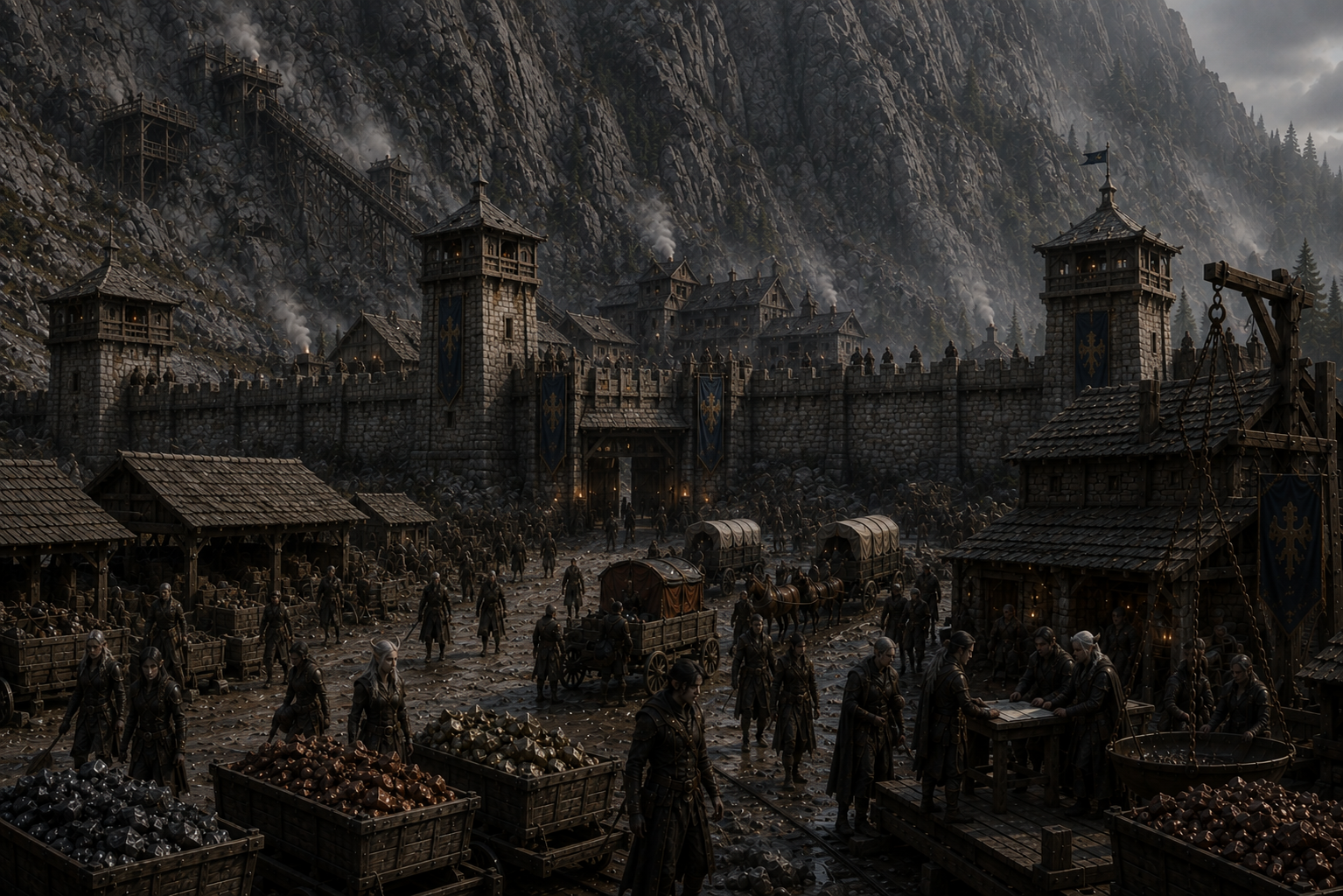
Ironcrest Outpost is a fortified mining settlement, caravan yard, ore exchange, and defensive checkpoint built around a cluster of productive mines in the western reaches of Keynew.

The outpost is inhabited primarily by the Ashborn, whose affinity for harsh volcanic country, heat, smoke, stone, and difficult mountain terrain made the western mines a natural place for their communities to take root.

Iron, copper, tin, nickel, and lesser veins of rarer ores are cut from the surrounding rock, weighed under guard, stamped for transport, and sent east to foundries, smithies, shipyards, and military stores.

Because so much of Keynew’s raw metal passes through Ironcrest, the Ashborn maintain armed patrols, watchtowers, sealed storehouses, and strict cargo records throughout the settlement.

Origins and Purpose

An Ashborn Hold in the Western Reach

Ironcrest began as a guarded ore station established by Ashborn prospectors and mining families working the dangerous western ridges. What began as temporary shelters around several promising shafts gradually became a permanent community.

As production increased, the Ashborn reinforced the site with stone walls, signal towers, ore vaults, weigh houses, workshops, communal halls, and guarded wagon yards. The result is part mine, part fortress, and part ancestral home.

Its strategic importance grew as Keynew became increasingly dependent on Ironcrest metal. A disruption here can slow construction, drive up weapon prices, strain shipbuilding, and create shortages across several cities at once.

The Ashborn did not create every tunnel beneath Ironcrest. Some of the deepest shafts break into broader, older passages whose stonework is unmistakably dwarven, remnants of mining works that predate the modern outpost.

The Ashborn of IroncrestPermanent Inhabitants

A Community Forged Around the Mines

Ironcrest is not merely a work camp. For its Ashborn inhabitants, it is home. Families live within the fortified compound, children grow up beneath the sound of shift bells and ore carts, and generations of miners have worked many of the same shafts.

Mining families form the heart of the community, supported by Ashborn smiths, engineers, stonecutters, guards, teamsters, surveyors, healers, and merchants. Outsiders regularly arrive to trade or work contracts, but the permanent population remains overwhelmingly Ashborn.

Hard labor carries little stigma here. Skill with stone, metal, ventilation, reinforcement, smelting, and underground survival is respected, and an experienced miner can hold as much social standing as a wealthy caravan master.

The Ashborn see Ironcrest as proof that their people can turn an unforgiving landscape into something enduring without surrendering the harsh character of the western mountains.

The Mines of Ironcrest

Rich Veins Beneath the Ridge

The surrounding hills are honeycombed with active shafts, drainage tunnels, ventilation chimneys, timbered galleries, and ore lifts. Some mines are shallow and heavily worked; others descend far enough that Ashborn crews spend entire shifts without seeing daylight.

The most common export is raw iron ore, but Ironcrest is also known for copper, tin, lead, and occasional pockets of unusually pure metal that command high prices from master smiths.

Ashborn miners regularly find sealed side passages, collapsed stone corridors, and carved supports far older than the current workings. The most persistent rumor holds that certain lower tunnels eventually intersect the abandoned mines once connected to Dragonsmane.

No official survey confirms the connection. Ashborn delving crews treat the oldest passages cautiously, while dwarven historians, prospectors, smugglers, and treasure hunters continue trying to prove the old stories true.

The Fortified Trade Hub

Ore, Coin, and Armed Caravans

Ironcrest functions as the western metal exchange for Keynew. Ashborn crews bring ore up from the mines, sort it by quality, weigh it, seal it into marked loads, and assign it to guarded caravans.

Visiting merchants rarely linger longer than necessary, but the Ashborn inhabitants have built a functioning community behind the industrial yards. Workshops, communal kitchens, family quarters, smith sheds, barracks, supply depots, counting rooms, and fortified storehouses fill the interior.

Caravans leaving Ironcrest often travel under contract escort. Attacks on metal shipments are treated as a serious regional crime, since stolen ore can quickly become weapons, contraband, or leverage against local rulers.

In busy seasons the road outside the walls becomes a temporary forest of wagons, pack animals, guards, repair crews, and traders waiting for their turn at the Ashborn-run scales.

Notable Features

Landmarks Within the Outpost

The Ironcrest Gate: A broad, riveted gate built to admit ore wagons three abreast. Ashborn wardens inspect every inbound and outbound load.

The Great Weigh House: The commercial heart of the outpost. Massive balance scales determine tariffs, contracts, and ownership before ore leaves the compound.

The Deep Shaft: The oldest active mine entrance at Ironcrest. Its lower levels contain worked stone that predates the Ashborn settlement by centuries.

The Ember Hall: A large communal hall used for meals, clan gatherings, contract announcements, memorials for lost miners, and decisions affecting the outpost as a whole.

The Black Vaults: Reinforced stone warehouses used for high-value ore, tools, blasting powder, and metal awaiting escorted transport.

The Crest Towers: Watchtowers positioned along the ridge and walls. Signal fires can warn nearby patrols and caravan routes of raids or mine emergencies.

The Ore Road: A heavily traveled route connecting Ironcrest to the broader Keynew road network and industrial markets farther east.

Life at Ironcrest

A Place of Shifts, Bells, Smoke, and Dust

Life at Ironcrest follows the rhythm of the mines. Shift bells divide the day, ore carts rattle through reinforced passages, forge smoke hangs above the workshops, and mineral dust settles over nearly everything.

Ashborn families have adapted their homes and routines to the industrial environment. Heavy shutters keep out grit, communal wash houses stand near the residential halls, and most homes keep mining masks, lanterns, rope, and emergency tools within easy reach.

Dwarves and other outsiders are welcome as contracted specialists, merchants, or travelers, but they are visitors rather than the defining population. Dwarven stoneworkers are particularly valued when crews encounter the ancient construction buried beneath the modern mines.

Memorial plaques hammered from scrap iron record the names of Ashborn lost to collapses, fires, bad air, and other mining disasters.

Hazards of the Mines

The Mountain Takes Its Share

Mine collapses, bad air, flooding, unstable shafts, gas pockets, machinery failures, and sudden cave-ins remain constant dangers. Experienced Ashborn crews carry signal whistles and mark safe routes with paint, chalk, or hammered metal tags.

The deeper workings pose stranger dangers. Unmapped drafts come from sealed passages, tool marks appear where no current crew has worked, and old dwarven stone sometimes emerges behind freshly cut rock.

Travel beyond authorized galleries is forbidden without an Ashborn survey crew and armed escort. Ironcrest’s leaders consider the unknown lower levels a threat to the entire settlement, not merely an opportunity for treasure hunters.

Relations with Dragonsmane

Mining in the Shadow of a Dwarven Past

The possible connection between Ironcrest and Dragonsmane is one of the outpost’s oldest unresolved mysteries. The Ashborn know they are working above the remains of a much older dwarven mining network, but no one knows how extensive it truly is.

Some Ashborn believe the old tunnels are simply abandoned infrastructure waiting to be reclaimed. Others argue that the dwarves sealed portions of the mountain deliberately and that breaking through those barriers could endanger everyone at Ironcrest.

For now, the deepest discoveries are mapped, marked, and reported before excavation continues.

Adventure HooksCampaign Use

Trouble Beneath Ironcrest

The Sealed Gallery: An Ashborn mining crew breaks through an ancient dwarven wall and disappears before the passage can be secured.

The Missing Ore Train: A caravan carrying unusually pure iron vanishes between Ironcrest and the eastern roads.

Smoke Below: Miners report smoke rising from a shaft where no forge, fire, or active crew should exist.

The Old Claim: A dwarven delegation arrives insisting that the deepest workings belong to the heirs of Dragonsmane, creating a tense dispute with the Ashborn families who have lived and worked at Ironcrest for generations.

The Broken Bell: The main shift bell rings in the middle of the night without anyone touching it. Minutes later, something begins hammering against a sealed tunnel door from the other side.