Ember Hollow

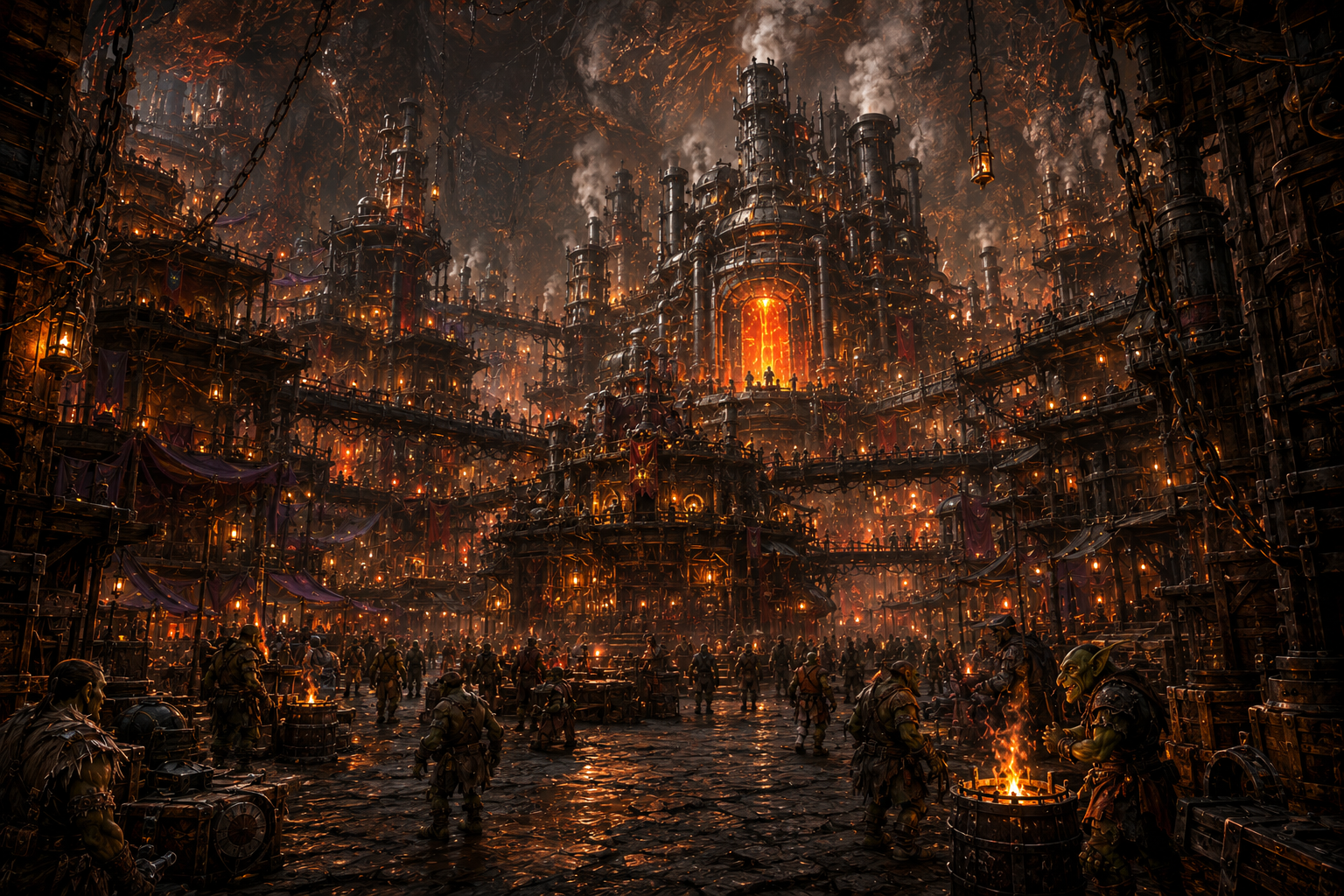
Hidden beneath the volcanic foothills of Dragonsmane, Ember Hollow is a sprawling goblin settlement built inside the remains of an old dwarven outpost. What began as a fortified support station for the great dwarven stronghold has become a noisy maze of patched metal, furnace glow, steam pipes, rope bridges, fungus farms, scrap towers, and goblin ingenuity.

Ember Hollow of Abadonya
Settlement Overview Keynew • Dragonsmane Western Reach

A Dwarven Outpost Reborn

Long before goblins claimed the caverns, Ember Hollow served the dwarves of Dragonsmane as a fortified outpost, supply depot, repair station, and access point into the lower mountain roads. Thick dwarven walls, reinforced galleries, old lift shafts, and stone-cut tunnels still form the bones of the settlement.

The dwarves are gone, but the outpost did not remain empty. Goblins moved into the abandoned halls and rebuilt them according to their own needs. Stone chambers became workshops, barracks became warrens, loading platforms became markets, and dwarven foundries were patched back into operation with scrap, stolen parts, and a dangerous amount of confidence.

Today Ember Hollow is one of the strangest settlements in western Keynew: half ancient dwarven military architecture and half improvised goblin city. Visitors often describe it as a place that appears to be moments from disaster while somehow continuing to function year after year.

The Hollow BelowAppearance & Atmosphere

Firelight Beneath the Mountain

Ember Hollow fills a network of broad caverns and worked dwarven halls beneath the lower slopes of Dragonsmane. Orange furnace light glows from cracks in black stone while steam whistles through copper pipes and iron chimneys. Walkways cross open shafts, minecarts rattle along old tracks, and hanging platforms sway above deeper caverns.

Dwarven masonry is everywhere: square pillars, fitted basalt blocks, carved drainage channels, old gatehouses, and heavy doors that were built to survive siege. The goblins rarely remove these structures. Instead they bolt, weld, rope, nail, and balance new construction directly onto them.

The result is chaotic but unmistakably alive. The settlement smells of hot iron, smoke, oil, fungus stew, alchemical reagents, and the ever-present mineral heat of the mountain.

Government & Goblin LifeRule by Spectacle

Chief Anarkizt Skraggit

Ember Hollow is ruled by Chief Anarkizt Skraggit, an inventor, war-chief, and enthusiastic patron of anything that explodes loudly enough to impress a crowd. Skraggit's authority rests less on formal law than on reputation, personal loyalty, successful inventions, and the understanding that challenging him usually becomes a public event.

Goblin society within the Hollow prizes cleverness, salvage skill, bravery, speed, and the ability to turn discarded material into something useful. A goblin who can repair a steam valve, win an arena bout, invent a better bomb casing, or find a valuable piece of dwarven metal can rise quickly in status.

Despite the settlement's dangerous reputation, Ember Hollow is not simply a camp of raiders. Families live here, food is farmed in warm mushroom chambers, children are taught basic engineering and fire safety, and entire neighborhoods depend on shared pipes, furnaces, lifts, and water channels.

Major LocationsPlaces Within Ember Hollow

The Blastforge

The industrial heart of Ember Hollow occupies one of the largest surviving dwarven forge halls. Goblin smiths, alchemists, machinists, and scavengers produce weapons, tools, pressure engines, crude mechanical devices, mining equipment, and an alarming variety of experimental inventions.

Sootmarket

A crowded bazaar spread across old loading platforms and warehouse halls. Visitors can find dwarven salvage, secondhand armor, alchemical reagents, monster parts, fungus beer, tools, stolen goods, strange prototypes, and objects whose original purpose has been completely misunderstood by their current owners.

Geargut Arena

A fighting and entertainment pit assembled across reinforced dwarven industrial platforms. Traditional fights share the schedule with mechanical contests, obstacle races, invention demonstrations, monster exhibitions, and dangerous competitions that most outsiders would refuse to call organized sport.

The Cinder Warrens

The residential heart of the settlement. Former dwarven barracks, storage halls, and side galleries have been divided into pipe-homes, workshops, family dens, communal kitchens, nurseries, and mushroom farms.

The Gutterways

Old dwarven drainage tunnels and cooling channels run below the settlement. They now carry runoff, condensation, waste water, and the occasional small boat or scavenger. Goblins use the safer passages as shortcuts, though outsiders are warned that the lower channels become confusing very quickly.

Scrapyard Stacks

Great towers of salvaged metal, broken carts, armor, gears, machinery, beams, chains, and dwarven wreckage rise through several cavern levels. Salvage crews constantly climb and rearrange the piles as new material arrives.

Dwarven RemainsThe Old Outpost

Stone Beneath Scrap

Ember Hollow's dwarven origins are impossible to ignore. Old defensive doors still divide sections of the settlement. Faded military symbols can be found beneath soot. Deep anchor points in the walls once held cargo lifts large enough for armored wagons. Some passages are clearly roads rather than mines, suggesting the outpost once handled significant movement to and from Dragonsmane.

Goblins treat much of this stonework practically. A carved lintel might support a steam pipe; an old guardroom might become a tavern; a dwarven shield rack might hold cooking pans. Yet even Ember Hollow has places its people avoid. Several sealed doors and lower passages remain unopened, either because their mechanisms no longer work or because repeated attempts to force them have ended badly.

Dwarven travelers sometimes react strongly to Ember Hollow. Some see the goblins as desecrators. Others quietly admit that the settlement may be the only reason the ancient outpost has not collapsed into ruin entirely.

Trade & VisitorsSalvage Economy

What Ember Hollow Trades

Ember Hollow trades in salvage, metalwork, repaired tools, mining supplies, alchemical goods, fungus products, scrap machinery, unusual weapons, dwarven relic fragments, and experimental devices. Merchants willing to accept uncertainty can sometimes buy extremely useful equipment for remarkably little coin.

The settlement also purchases what it cannot easily produce underground: grain, cloth, wood, lamp oil, leather, livestock, medicinal herbs, glassware, and refined chemicals. Scrap metal is always welcome, regardless of where it came from.

Outsiders are permitted in much of Ember Hollow, especially traders, mercenaries, adventurers, repair specialists, and anyone carrying interesting machinery. Visitors are expected to respect marked workshops, avoid touching active experiments, and never assume a warning sign is a joke merely because it is badly spelled.

Hazards of Ember HollowTravel Advisory

A City That Never Stops Moving

Ember Hollow is dangerous even when no one is trying to hurt anyone. Steam valves vent without warning. Minecarts share walkways with pedestrians. Scrap towers shift under their own weight. Experimental devices are tested in public. Sparks from the Blastforge drift through busy streets, and old dwarven tunnels occasionally shake when the mountain settles.

Locals react to these events with practiced efficiency. Bells, whistles, painted floor markings, shouted warnings, and elaborate hand signals tell residents when to duck, run, climb, or move something flammable.

Travelers who remain alert usually manage well. Travelers who ignore goblin warnings generally learn why the warnings existed.

Rumors & Local TalesWhat Travelers Hear

Stories Told in the Sootmarket

“The dwarves left whole rooms untouched.” Salvagers insist sealed chambers still exist behind sections of original outpost stone.

“Some doors don't want goblin tools near them.” Certain dwarven mechanisms reportedly jam, spark, or lock tighter when tampered with.

“There are roads under the roads.” Older goblins claim the visible tunnels are only the uppermost level of the original outpost.

“Skraggit can make anything work once.” Locals usually add that making it work a second time is someone else's problem.

“You can hear Dragonsmane when the mountain is quiet.” Some residents swear distant metallic sounds travel through the deepest stone during the night.

Campaign HooksAdventure Seeds

Reasons to Visit Ember Hollow

The Missing Salvage Crew: A group searching an abandoned section of the dwarven outpost has not returned, and the goblins want outsiders to investigate before anyone important notices.

The Broken Lift: One of the ancient dwarven cargo lifts suddenly begins moving again, carrying empty platforms up from a lower level no one remembers using.

A Very Expensive Piece of Scrap: A merchant recognizes an object in Sootmarket as a rare dwarven relic and hires adventurers to purchase it before someone else realizes its value.

The Quiet Blastforge: The furnaces shut down unexpectedly, threatening the settlement's trade and heat. Something is interfering with the old dwarven systems beneath the forge.

Skraggit's Demonstration: Chief Skraggit invites the party to witness a new invention. The machine works perfectly—until it decides to go somewhere else.