
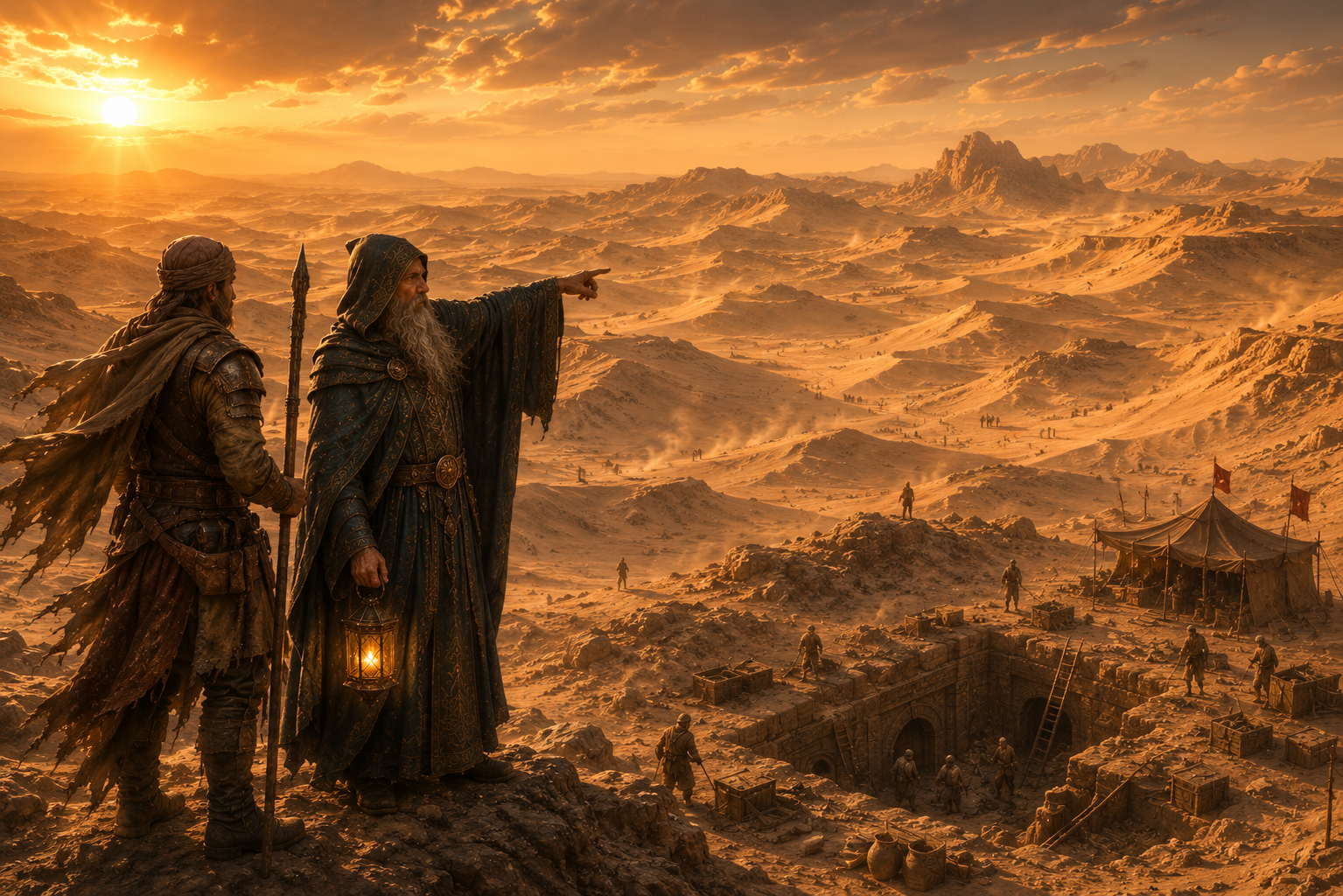
The Sunken Temple of Earth

A vast stretch of shifting dunes in southern Petra where legend claims an ancient temple was buried beneath the desert by deliberate and overwhelming magic. No tower breaks the horizon. No doorway waits to be opened. The temple is somewhere below — and generations of excavators have failed to find it.

The Sunken Temple of Earth in Abadonya
The Temple Beneath the Dunes Player Introduction

A Landmark Defined by What Cannot Be Seen

The Sunken Temple of Earth is not a visible ruin. The name describes an enormous sea of dunes, stone ridges, and wind-carved hollows where an ancient temple is believed to lie buried far below. Travelers crossing the region see only sand stretching toward the mountains, broken occasionally by black stone shelves that emerge for a season and vanish again beneath the next great storm.

According to Petra's oldest stories, the temple was not lost naturally. Someone wanted it gone. Powerful magic was used to drag earth and sand over the entire sanctuary until every tower, stair, road, and courtyard disappeared. What happened inside the temple — and why its enemies feared it enough to bury it — has been forgotten.

The Great Excavations Recorded History

Everyone Has Dug. No One Has Found It.

Scholars, treasure hunters, priesthoods, wealthy patrons, and rulers have all funded expeditions into the dunes. Trenches hundreds of feet long have been cut through the sand. Shafts have been driven downward until workers struck bedrock. Diviners have walked the wastes with rods, crystals, spells, and relics. Nothing has produced a confirmed entrance.

Some excavations uncover walls that lead nowhere. Others find stairways that descend for a few steps before ending in untouched stone. On rare occasions teams report carved pillars or fragments of decorated floor, only to return after a sandstorm and discover the entire site has vanished.

Because of this, veteran excavators have a saying: "The desert does not hide the temple. The temple hides itself."

A Burial Made by Magic Common Lore

Someone Wanted It Forgotten

The strongest piece of the legend is also the most widely accepted: the temple was deliberately buried. Natural dunes shift, but the land here behaves strangely. Trenches refill too quickly. Markers disappear. Exposed stone seems to sink. Entire excavation camps have awakened to find their carefully cleared dig sites covered by fresh, smooth dunes despite calm weather during the night.

Scholars disagree over who could have performed magic on such a scale. Some claim the builders buried their own sanctuary to protect what lay within. Others argue that an enemy erased the site after a war. A darker interpretation says the temple was entombed because something inside could not be destroyed.

The Dune Sea Traveler Guide

Crossing the Search Lands

The region surrounding the supposed temple is a wide, difficult wilderness of high dunes and deep troughs. Distances are deceptive. A ridge that appears close may require hours of climbing and circling to reach. Wind constantly reshapes the terrain, making old maps unreliable after only a few seasons.

Water is scarce, shade almost nonexistent, and excavation pits create their own hazards. Abandoned shafts sometimes remain hidden beneath thin crusts of sand. Travelers are warned not to enter old dig tunnels without experienced guides; many were dug hastily and were never reinforced.

Signs Left in the Sand Landmark Guide

What Explorers Actually Find

The Broken Camps: Rings of old stakes, shattered cranes, collapsed tents, rusted tools, and weathered supply crates from failed expeditions.

The False Stairs: Sections of stone stairway occasionally exposed by the wind. None yet discovered have led to a complete structure.

The Sinking Markers: Stone posts placed by surveyors that gradually disappear beneath otherwise undisturbed sand.

The Deep Stone: A layer of unnaturally hard material encountered by several excavations. Attempts to break through it have damaged tools and ended digs.

The Quiet Dunes: Areas where the desert wind abruptly dies. Locals dislike camping there and claim sound carries strangely beneath the sand.

Those Who Still Search Regional Interest

The Lost Temple Still Draws the Ambitious

Failed expeditions have not discouraged new ones. The possibility of discovering a temple untouched for centuries is enough to attract historians, adventurers, relic hunters, and wealthy sponsors. Old journals and incomplete survey maps trade for surprising sums in Petra's markets.

Zae'Halem keeps an interest in major excavations, especially when foreign wealth or large caravans pass through the region. Officially this is to protect travelers and regulate trade. Less charitable voices suggest that the Queen simply intends to ensure that anything valuable recovered from beneath Petra does not leave the region without her knowledge — or her tax.

What Travelers Whisper Rumors

Stories Beneath the Sand

Some claim the dunes move to bury anyone who digs too close to the true entrance. Others insist that several expeditions did find the temple and simply never returned. There are stories of bells heard beneath the earth at night, stone doors glimpsed during sandstorms, and footprints that appear on untouched dunes before descending straight into the sand.

One persistent tale says the temple can only be found by someone who is not searching for it. Another says the entrance has been uncovered many times, but a spell causes anyone who sees it to forget where it was the moment they leave.

Whatever the truth, the most unsettling part of the legend remains unchanged: someone once possessed enough power to bury an entire temple beneath Petra — and believed the world was safer if it was never found again.