The Glass Wastes

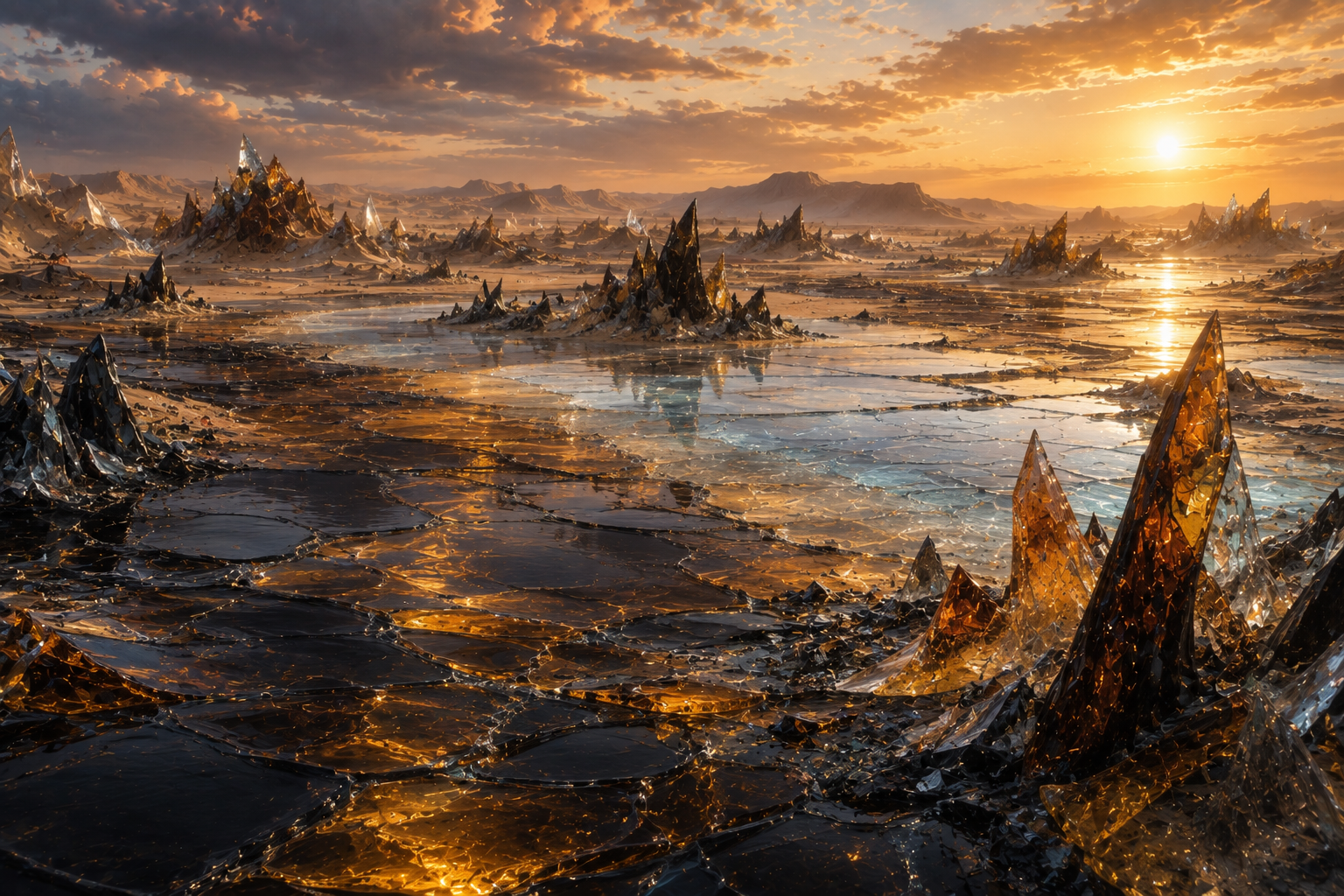
Across southern Petra lies a desert where the sand has been fused into shining sheets of glass. From a distance it resembles a frozen sea beneath the sun. Up close, it is one of the harshest and most deceptive landscapes in the region—and the principal homeland of Petra's Ifrit, whose fire-touched communities have learned to survive where most travelers can barely endure.

The Glass Wastes of Abadonya
The Glass Wastes Petra Landmark

A Desert Turned to Glass

The Glass Wastes are not ordinary dunes. Vast portions of the desert have been melted and hardened into black, amber, and pale-blue glass. Some stretches are smooth enough to reflect the sky like a mirror, while others have fractured into forests of razor-edged shards.

No one agrees on what created the Wastes. Some scholars blame an ancient magical catastrophe. Priests speak of divine fire. Caravan stories insist that something beneath the desert burned so hot that the sand itself surrendered. Whatever the truth, the event left behind a landscape that has never returned to normal.

Homeland of the Ifrit People of the Glass Wastes

Where the Fire-Touched Made Their Home

The Glass Wastes are the greatest concentration and ancestral heartland of the Ifrit in Abadonya. While individual families can be found throughout Petra, the Wastes are where their culture is strongest and where the oldest fire-touched bloodlines maintain permanent communities.

Ifrit settlements cluster around volcanic vents, sheltered glass formations, buried springs, black-glass ridges, and places where geothermal heat rises naturally through the fused desert. What appears uninhabitable to outsiders contains routes, wells, caves, and protected hollows known to generations of local families.

Their resistance to fire makes the extreme heat more manageable, but survival here still requires experience. Local Ifrit learn to read reflections, identify stable glass, locate hidden water, anticipate shardstorms, and navigate by landmarks that outsiders often mistake for mirages.

The Wastes have shaped their identity as much as their elemental heritage has. Glassworking, metalcraft, caravan guiding, fire magic, survival training, and the belief that dangerous forces must be mastered rather than merely feared are central to many communities.

Travel Through the Wastes Common Knowledge

Beautiful From Afar, Merciless Up Close

Most travelers go around the Glass Wastes rather than through them. During the day, sunlight reflects from the ground with painful intensity, turning the horizon into a shimmering wall of false shapes. At night, the glass gives up the heat it absorbed and the temperature can plunge with startling speed.

Wagons fare poorly here. Thin glass plates collapse beneath heavy wheels, while fractured fields can slice leather boots, animal hooves, and wooden axles. Windstorms are worse: loose shards become airborne and sweep across exposed ground like knives.

Experienced Petra guides carry tinted veils, wrapped footwear, spare water skins, and long poles used to test the surface ahead. Travelers who cross without a guide are usually either desperate, overconfident, or hiding from the Queen's roads.

For this reason, Ifrit guides are considered the finest authorities on crossing the Wastes. Even experienced Petra caravan masters often hire them before attempting routes through the Mirror Flats or Shardfields.

Mirrors, Heat & False Horizons Traveler Lore

The Wastes Lie to the Eyes

Reflections make navigation difficult. A distant caravan may appear beside you when it is miles away. A rock spire can seem to float upside down. Pools of reflected sky are easily mistaken for water, and entire sections of the horizon seem to split into duplicate landscapes.

Locals warn travelers never to follow a figure seen only in reflection. The practical explanation is simple: heat shimmer and polished glass create dangerous illusions. The superstitious explanation is that the Wastes remember everyone who has died upon them and sometimes show those memories to the living.

Zae'Halem and the Wastes Regional Politics

Beyond the Queen's Safest Roads

The Queen of Zae'Halem does not claim the Glass Wastes as a settled territory, but her influence reaches their edges. Patrols watch the safer approaches, especially where smugglers and untaxed caravans attempt to leave the monitored Glass Road and disappear into the desert.

This has given the Wastes a second reputation: they are one of the few places in Petra where a determined traveler might avoid official toll stations. The tradeoff is severe. The desert may not collect taxes, but it often collects something far more valuable.

The Queen's authority is also complicated by the long-established Ifrit communities within the Wastes. These settlements do not view themselves as temporary desert camps; many predate modern patrol routes and consider the glass desert their homeland rather than empty territory.

Notable Features Landmark Guide

Places Named by Travelers

The Mirror Flats: A broad, nearly unbroken sheet of pale glass where the sky is reflected so clearly that travelers sometimes feel they are walking between two heavens.

The Shardfields: Miles of broken, upright glass fins. Wind passing through them produces a low ringing sound that can be heard long before the field is visible.

The Black Melt: A dark basin of warped glass where the surface looks as though it cooled while still flowing. Guides avoid camping nearby.

The Sunscar: A long line of fused glass so bright at midday that it can be seen from distant ridges. Some claim it marks the path of whatever created the Wastes.

What Travelers Whisper Rumors

Stories Carried Out of the Desert

Some say entire caravans can be seen beneath clear sections of glass, perfectly preserved where the desert swallowed them. Others claim certain shards remain warm even at midnight. There are stories of lights moving beneath the surface, of footprints appearing where no one walked, and of a buried road visible only at sunrise.

The oldest guides repeat one warning more than any other: if the glass begins to hum while there is no wind, leave the area immediately. None of them agree on what the sound means.