Hero’s Road

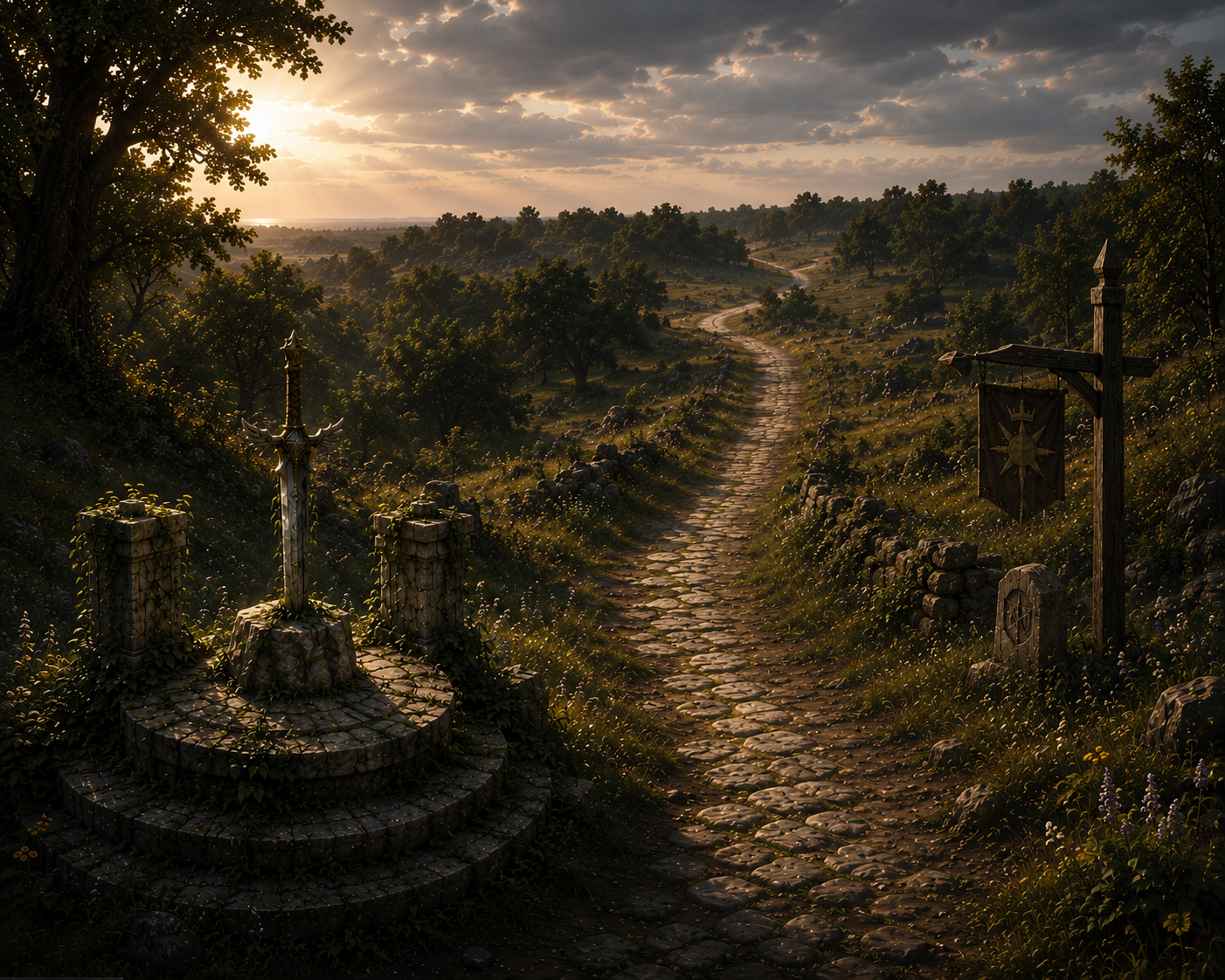
The historic overland route between Mendiville and Golandria, remembered across Keynew as the path taken by the Hero who journeyed from Mendiville toward Golandria before the final struggle against the Mad Sage. Today the road is both a practical trade route and a living memorial.

Hero’s Road of Abadonya
Landmark Overview Keynew • Historic Road

The Road of the Hero

Hero’s Road stretches across central Keynew from Mendiville toward Golandria. Long before it received its current name, it was an ordinary merchant road connecting the interior with the coast.

Tradition holds that the Hero who ultimately defeated the Mad Sage followed this route after leaving Mendiville. Generations later, the road was formally renamed in remembrance of that journey.

Not every mile of the original path can be proven, and different villages tell slightly different versions of where the Hero rested, fought, prayed, or met companions. The route itself, however, is accepted throughout Keynew as part of the region's shared history.

From Mendiville to Golandria The Historic Journey

A Path Remembered

The road begins near Mendiville, where local tradition places the beginning of the Hero's westward journey. From there it follows rolling country, old crossings, farm roads, and long stretches of open trail before continuing toward Golandria.

The exact route has shifted over the centuries as bridges were rebuilt, floods altered lowlands, and new roads were cut. Even so, the modern road intentionally follows the traditional path as closely as possible.

Roadside Memorials Markers of Remembrance

Stones, Ribbons, and Small Shrines

Hero’s Road is lined with simple memorials rather than grand monuments. Travelers encounter carved stones, old mile markers, roadside shrines, weathered plaques, and trees wrapped with ribbons left by pilgrims.

The First Stone: A carved marker near Mendiville traditionally said to mark where the Hero committed to the journey toward Golandria.

The Resting Oak: An ancient roadside tree beneath which the Hero is said to have slept for one night.

The Broken Mile: A cracked stone marker preserved rather than replaced because local tradition says the Hero passed it while wounded.

The Golandrian Marker: A later monument near the coastal approach noting the end of the remembered journey.

Pilgrims & Travelers Road Culture

Walking in the Hero's Footsteps

Some residents of Keynew walk portions of Hero’s Road as an act of remembrance, especially after personal hardship, military service, or the death of a family member.

Pilgrims commonly carry a small stone from Mendiville and leave it near Golandria, symbolizing the burdens carried from the beginning of a journey to its end.

Merchants and ordinary travelers use the road just as often. The memorial status of the route does not prevent wagons, livestock, caravans, or patrols from using it as a working road.

Road Conditions Travel Notes

A Well-Traveled Route

Hero’s Road is maintained better than many rural routes in Keynew because of its historic importance and steady traffic. Major washouts and damaged bridges are usually repaired quickly.

Even so, long stretches remain exposed to weather. Heavy rain can turn low sections muddy, summer heat leaves little shade in open country, and winter travel can become slow and difficult.

Travelers should not assume the road is completely safe. Bandits and opportunists tend to avoid the most frequently patrolled sections but remain a threat farther from Mendiville and Golandria.

Traditions of the Road Regional Customs

Remember the Journey, Not Just the Victory

A common saying along Hero’s Road is, “The victory happened at the end, but the choice happened on the road.” Parents use the phrase when teaching children that great deeds begin with smaller decisions.

Damaging a memorial marker is considered deeply disrespectful. Travelers who find fallen stones often set them upright, even when they do not know who originally placed them.

It is also customary for travelers passing another person walking the route alone to offer water, food, or at least a greeting before continuing onward.

Stories of the Hero Popular Lore

History Worn Smooth by Retelling

Every community along the route claims some connection to the Hero's journey. One family insists an ancestor gave the Hero bread. Another says the Hero repaired a farmer's fence before continuing. A roadside inn once claimed the Hero slept there despite being built generations later.

Historians separate documented events from folklore, but most people along the road care less about exact proof than about what the stories represent: courage, endurance, and the decision to continue when turning back would have been easier.

Rumors & Road Tales What Travelers Hear

Stories Carried Between Cities

Some travelers claim that anyone walking Hero’s Road with a truly important purpose dreams of Golandria before ever seeing its walls.

Others say one of the oldest memorial stones bears writing that appears only in moonlight, though no two witnesses agree on what it says.

A persistent story tells of a lone traveler occasionally seen walking the road toward Golandria at dusk, always just beyond speaking distance and never present by morning.

Campaign Hooks Adventure Seeds

Reasons to Travel Hero’s Road

The Stolen Marker: One of the oldest memorial stones disappears overnight, and several nearby communities demand its return.

The Broken Pilgrimage: A pilgrim traveling from Mendiville toward Golandria vanishes between two well-used rest points.

The Forgotten Turn: An old map suggests the historical road once followed a branch that no longer appears on modern charts.

The Hero’s Message: A newly uncovered roadside carving appears to reference an event absent from the accepted story of the Hero's journey.