Venj — The Oasis in the Crack

A major city of Petra carved into a colossal canyon where desert, oasis, and sea meet. Venj is beautiful, wealthy, and precarious — a city whose bridges and water gates hold as much political power as armies do elsewhere.

Venj Oasis in Petra, Abadonya
The City of Venj Player Introduction • Major City

A City Carved into the Desert

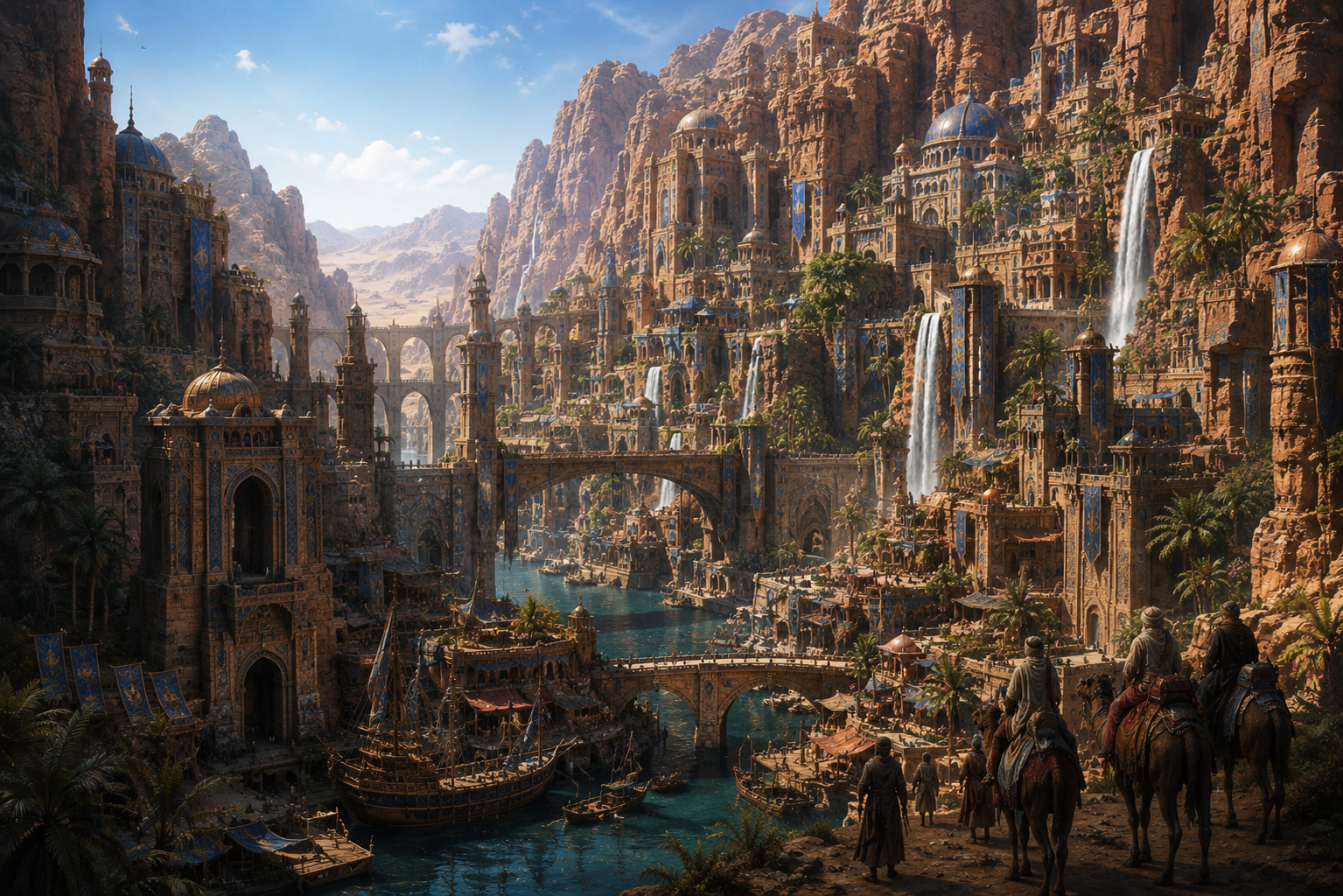
Venj is not built on the desert. It is carved into it. Far south of the trade routes, where dunes roll like golden oceans, the land suddenly splits — a colossal canyon torn into the earth as if struck by a divine blade. Within that fracture lies Venj.

The city clings to the canyon walls in layered terraces of sandstone, white marble, and sun-baked brick. Buildings rise vertically instead of outward. Hundreds of bridges stretch across the open air, swaying gently above a drop that descends nearly a thousand feet.

At the canyon's deepest point, fresh water springs from the stone itself, forming a lush oasis that feeds gardens, date groves, and terraced farms. That water continues downward, cutting through rock, and eventually spills out through a coastal break where Venj “leaks” into the sea — creating a natural harbor hidden from most maps.

The desert above is harsh and merciless. Inside Venj, life blooms.

What Every Traveler Knows

Climate & Atmosphere

The upper terraces are hot, dry, and constantly sun-blasted. The lower oasis levels are humid and alive with greenery, while sea mist sometimes drifts upward from the ocean breach. At night, the canyon traps cool air and glowing lanterns turn the bridges into bright threads suspended in darkness.

Wind is constant here. It whistles between towers, hums through bridge cables, snaps silk awnings, and carries voices farther than expected. Travelers who fear heights quickly learn that Venj offers few places to hide from the open air.

Government & Power

The Council of Tides

Venj is officially ruled by the Council of Tides, a collection of influential merchant houses whose wealth rests on control of the city's most essential systems. The Council oversees water access, bridge maintenance, harbor trade, and caravan taxation.

Unofficially, power belongs to whoever controls the bridges and water gates. Water is wealth. Bridges are leverage. A closed span can isolate a neighborhood from markets, cisterns, or the harbor; a restricted gate can decide which farms flourish and which districts go thirsty.

The Council presents itself as a single governing body, but every traveler quickly hears that its member houses compete fiercely behind closed doors. Venj rarely settles disputes through armies. It settles them through access, tariffs, favors, routes, and pressure.

Trade & Economy

Where Desert Roads Meet the Sea

Venj is one of Petra's great convergence points. Desert caravans arrive from inland spice routes while ships enter through the canyon-mouth harbor below. Goods move vertically through lifts, stairways, pack trains, pulleys, and bridge markets before continuing into the wider world.

Common exports include rare desert spices, polished sandstone and marble, oasis-grown fruit wines, and pearl or coral goods from the hidden harbor. Imported lumber, metals, cloth, tools, and luxury goods are equally valuable because so much must be hauled into the canyon from afar.

Venj also has a reputation for discreet meetings, private trade agreements, and cargo that never quite appears in an official ledger. If something needs to change hands quietly, Venj provides hundreds of bridges, cellars, docks, terraces, and shaded courtyards in which to do it.

Culture & Daily Life

Balance Above the Deep

Venj culture blends desert resilience with ocean adaptability. Hanging gardens stretch between buildings. Silk awnings shade market walkways. Musicians perform from wide bridge platforms. Children race across rope walkways with a confidence that horrifies newcomers. Priests bless cisterns before major festivals and inspect public fountains as carefully as shrines.

Locals value balance, bargaining skill, adaptability, and respect for water. Wastefulness is considered vulgar, and to deliberately waste clean water in public is one of the quickest ways to offend an entire street.

Many families identify strongly with the terrace, bridge, or water gate nearest their home. Directions are often given vertically — “two bridges down,” “above the spice span,” or “below the third cistern” — rather than by compass point.

Temples & Beliefs

Water, Travel, Trade & Survival

Venj's religious life centers on deities associated with water, travel, trade, and survival. Small shrines stand at bridge entrances. Sailors pray before leaving the harbor. Caravan leaders leave coins at cistern altars. Water stewards often receive blessings before opening major gates.

A persistent local belief holds that the canyon itself is sacred — not because it is beautiful, but because it is a wound. Old stories claim the fracture was left by something ancient, divine, or catastrophic. No single temple agrees on what caused it, only that Venj exists because the earth was once split open.

Districts of Venj

1. The Sun Terrace — Upper Level

The highest inhabited tier faces the full punishment of the desert sun. Caravan gates, guard posts, taxation halls, counting houses, and many noble estates dominate the ledges here. Most outsiders first enter Venj through the Sun Terrace, where their names, goods, and debts are recorded.

2. The Bridge Markets — Mid-Level

Venj's most famous district is built directly onto its broadest bridges. Open-air markets crowd the spans beneath layered awnings, with merchants calling across the wind and porters weaving through foot traffic. Food, spice, jewelry, tools, maps, contracts, rumors, and secrets are all traded here. When Venj feels crowded, it is usually because the Bridge Markets are alive.

3. The Verdant Hollow — Lower Oasis

The canyon's green heart surrounds the freshwater springs. Gardens, farms, date groves, artisan quarters, mills, and waterworks fill stepped terraces around pools and channels. The air is cooler, wetter, and heavy with plant life. Many locals consider this the true soul of Venj.

4. The Seabreach Harbor — Ocean Mouth

At the canyon's lowest outlet, freshwater channels meet the sea. Hidden docks and salt-stained warehouses shelter foreign ships, local traders, smugglers, pilots, and crews who know how to navigate the narrow approach. The harbor is hard to see from open water and harder still to enter without someone who knows the tides.

What Travelers Whisper

Rumors Heard on the Bridges

Bridges have been sabotaged before, though officials rarely say by whom. Some residents insist that something moves in the deepest shadows of the canyon at night. Water gates have reportedly opened without authorization. Merchants claim the Council of Tides is more divided than it appears.

Another story says a powerful artifact once passed through Venj and vanished somewhere between the upper caravan halls and the Seabreach Harbor. Every version of the tale names a different merchant house, bridge, ship, or shrine.

Venj looks stable. But it hangs in the air — literally and politically.

Arriving in Venj

A City of Leverage

To newcomers, Venj is vertical, crowded but isolated, beautiful but precarious, wealthy but tense. Its towers and terraces seem permanent until the wind moves a bridge beneath your feet. Its markets look free until a gate closes. Its water looks abundant until someone reminds you who controls it.

This is not a city of armies. This is a city of leverage.

And you have just arrived.