Zae'Halem — The Queen's City of Sand

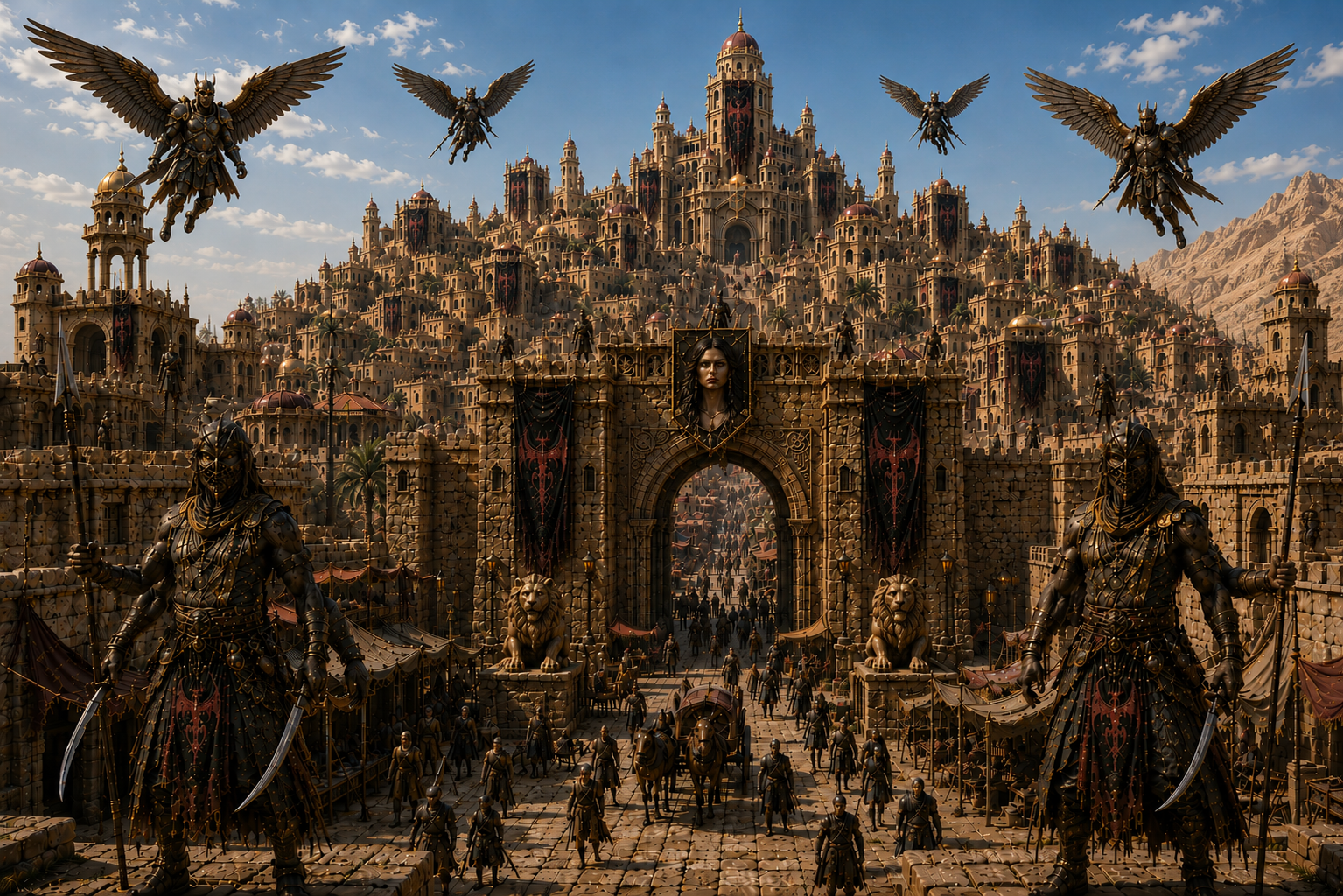
Zae'Halem is one of Petra's newest cities, raised from the desert by the will of its newly appointed Queen. Where there had once been only wind-scoured dunes, sandstone walls, towers, markets, roads, and fortified gates now stand beneath the relentless southern sun. The city grew quickly, and so did the Queen's authority. In Zae'Halem, trade does not merely pass through the city — it passes through her hands. Among the most visible signs of her new rule are the Tetrani, once wandering desert tribes, many of whom have now taken residence in the city and serve as guards, escorts, gate wardens, and trusted protectors of the Queen. Above them, Vesperan scouts patrol the skies and mountain approaches. Most Vesperan in Petra reside in Zae'Halem or along the surrounding mountainsides, and the Queen has incorporated many of them into her standing army as aerial scouts, messengers, patrols, and soldiers used to extend her control across Petra.

Zae'Halem — The Queen's City of Sand in Abadonya
The City Raised from Sand Petra Location

A New Power in the Desert

Zae'Halem is a city without ancient foundations. Its streets do not follow forgotten roads, and its walls were not inherited from some dead empire. The city is recent, deliberate, and unmistakably the creation of its ruling queen. Travelers say she commanded the desert itself to yield stone and sand for the construction, and that entire sections of the city seemed to rise from the dunes in a matter of seasons.

Whether that story is literal magic or royal myth hardly matters to the people who live here. Zae'Halem exists because the Queen willed it to exist, and nearly every monument, gate, plaza, and public inscription reminds visitors of that fact.

The city is built in broad tiers of pale sandstone broken by shaded courtyards, high walls, cloth canopies, reflecting pools, and narrow streets designed to keep the worst of the desert heat away from pedestrians. Tall watchtowers overlook the approaches for miles.

The Queen's Dominion Government & Power

One Crown, One Market

Zae'Halem is ruled directly by its queen. There is no merchant council powerful enough to challenge her, no hereditary senate sharing authority, and no independent trade league permitted to operate beyond her reach. The Queen's officials license merchants, record caravans, inspect cargo, set tariffs, and collect taxes at every major gate and counting house.

Her rule is simple enough for even a first-time visitor to understand: pay the Queen's tax, respect her laws, and the city will protect your business. Refuse, cheat the scales, conceal cargo, or attempt to bypass her authority, and the Queen's wrath is swift.

Merchants who obey the rules often praise Zae'Halem as unusually safe for a desert trade city. Contracts are enforced, caravan theft is punished harshly, and major roads near the city are patrolled. Those same merchants are usually careful not to complain too loudly about how much of their profit belongs to the crown.

Much of this authority is now enforced by the Tetrani who entered the Queen's service after she gave their wandering tribes a place inside Zae'Halem. Their loyalty is tied directly to the new crown, making them both protectors of the city and a visible symbol of the Queen's newly established rule.

The Queen's reach extends beyond the roads through the service of the Vesperan. From Zae'Halem and the mountain slopes of Petra, Vesperan patrols watch caravan routes, settlements, passes, and distant approaches from the air. Their reports allow royal forces to respond to raiders, suspicious movements, and challenges to the Queen's authority long before conventional ground patrols could arrive.

The Tetrani Guard Royal Protection & New Citizens

From Wandering Tribes to the Queen's Shield

Since taking the throne, the Queen has drawn many Tetrani tribes into Zae'Halem, offering them secure water, shelter, legal protection, and permanent quarters within the city.

In return, the Tetrani have become one of the most visible pillars of her new regime. Their endurance, desert mobility, four-armed fighting style, and strong clan discipline make them ideal guards in a city built around gates, caravan traffic, royal authority, and long desert approaches.

Tetrani units now occupy barracks near the Crown Gate, the Sandstone Crown, and several important cisterns. They serve as palace guards, royal escorts, gate wardens, caravan outriders, internal patrols, and trusted protectors assigned to high-value officials, merchants, and visitors under the Queen's protection.

Their presence is more than military. Entire Tetrani families have begun settling in Zae'Halem, establishing clan halls, workshops, training courts, and neighborhoods that preserve the customs of the old wandering tribes. For many, this is the first permanent home their people have ever known.

The Vesperan Scouts Eyes of the Queen

Wings Over Petra

Most of Petra's Vesperan reside in Zae'Halem and along the mountainous sides of the region. Their cliffside communities, high roosts, and hidden landing places give them access to terrain that ordinary patrols struggle to reach.

The Queen has brought many Vesperan into her standing army, where they serve as aerial scouts, messengers, patrols, and soldiers. Their ability to cross broken terrain rapidly and observe movement from high above makes them invaluable to a ruler determined to maintain control over Petra.

Vesperan scouts range far beyond Zae'Halem's walls. They watch caravan roads, mountain passes, isolated settlements, desert approaches, and suspected raider routes. A caravan may travel for hours believing itself alone while a Vesperan patrol circles silently far overhead.

Information gathered by the Vesperan is carried back to Zae'Halem with remarkable speed. This aerial network allows the Queen to know about unusual troop movements, dangerous creatures, missing caravans, unauthorized camps, and potential unrest before many local authorities do.

Together, the Vesperan and Tetrani give the Queen two very different military strengths: the Tetrani hold gates, roads, royal positions, and ground patrols, while the Vesperan dominate reconnaissance, communication, mountain surveillance, and the open skies above Petra.

Trade Beneath the Crown Economy

The Price of Doing Business

Zae'Halem was founded where desert routes could be controlled rather than merely observed. Its gates sit astride important caravan paths, and merchants traveling deeper into Petra often find that avoiding the city costs more time, water, and coin than simply entering and paying the levy.

Trade in Zae'Halem commonly includes:

  • Desert spices, salts, incense, dyes, and preserved foods.
  • Cut stone, worked sandstone, glass, ceramics, and metal goods.
  • Imported cloth, timber, wine, tools, and luxury cargo from foreign routes.
  • Water contracts, caravan permits, guarded passage, and warehouse space.

Every major transaction generates a record. Every warehouse bears a royal seal. Every caravan leaving the city receives papers proving that its taxes have been paid. A merchant without those papers may quickly discover that the next royal patrol is far less interested in excuses than coin.

Districts of Zae'Halem City Guide

The Crown Gate

The city's principal caravan entrance is a monumental sandstone gate flanked by tax halls, guard barracks, inspectors, animal yards, and shaded waiting courts. Most newcomers form their first impression of Zae'Halem here — orderly, impressive, and impossible to enter unnoticed.

The gate is now heavily staffed by Tetrani wardens and inspection teams. Their reputation for alertness, endurance, and coordinated combat has made the Crown Gate one of the most tightly controlled entrances in Petra. High above the gate, Vesperan watchers monitor approaching caravans and riders long before they reach the walls.

The Royal Exchange

A vast market district filled with permanent shops, caravan stalls, counting houses, auction platforms, money changers, and crown clerks. Prices are competitive, but every merchant operates under royal license. The Queen's seal appears almost as often as the merchants' own signs.

The Sandstone Crown

The elevated heart of royal power, containing the Queen's palace, audience courts, administrative halls, elite barracks, and residences of favored officials. Its terraces overlook much of the city. Access is controlled, and royal banners are visible from nearly every major avenue below.

The elite barracks here are occupied in large part by Tetrani royal guards who protect the palace, escort the Queen, and control access to the inner administrative terraces. Elevated platforms and towers nearby serve the Vesperan scouts attached to the Queen's standing army, allowing messages and reconnaissance reports to reach the palace directly from the air.

The Cistern Quarter

Zae'Halem survives because its water is managed with extraordinary care. Reservoirs, deep wells, covered channels, public fountains, bathhouses, and water offices fill this district. Water theft, sabotage, and contamination are treated as crimes against the entire city.

The Caravan Ward

Inns, stables, repair yards, warehouses, guides, animal merchants, and caravan companies crowd this outer district. It is loud at dawn, dusty by midday, and full of travelers by night. News from across Petra reaches the Caravan Ward before it reaches almost anywhere else.
Law, Culture & Daily Life What Travelers Should Know

Order Has a Price

Zae'Halem has attracted merchants, laborers, artisans, guards, builders, and opportunists from throughout Petra because new cities create new fortunes. Its population is ambitious and practical. Many residents arrived with nothing more than a trade, a contract, or the hope of becoming wealthy before the city's best opportunities were claimed.

Public loyalty to the Queen is common, though the reasons vary. Some genuinely credit her with bringing security, work, and prosperity to a dangerous stretch of desert. Others simply understand that criticizing the person who controls the markets, guards, wells, and courts is unwise.

Foreigners are welcome so long as they spend coin, obey the law, and remember that commercial privilege is granted by the crown. Travelers who treat Zae'Halem like an open frontier town often learn very quickly that it is anything but one.

The arrival of large numbers of Tetrani has also changed the city's culture. Their clan halls, four-armed training yards, desert textiles, inherited weapons, and oral traditions are becoming familiar sights in districts near the royal barracks and outer gates.

The Vesperan have become equally recognizable above the city. Their presence is strongest around towers, high terraces, cliff-facing districts, and military observation posts. Many maintain homes in Zae'Halem while remaining closely connected to Vesperan communities scattered across Petra's mountainsides.

What Travelers Whisper Rumors & Reputation
  • The Queen knows when a caravan has hidden cargo before the inspectors ever open a crate.
  • Some merchants would rather cross dangerous open desert than pay Zae'Halem's taxes twice.
  • The deepest cisterns were dug before the city was founded — or so the workers claim.
  • Royal agents quietly purchase rare artifacts and unusual relics that enter the market.
  • Several trade houses have become enormously wealthy by earning the Queen's favor.
  • No one can agree on exactly how much magic was involved in raising the city from the sand.
  • Some say the Queen trusts her Tetrani guard more than the city's older officers because their loyalty is to the ruler who finally gave their tribes a permanent home.
  • Travelers claim the Queen's Vesperan scouts can follow a caravan across Petra for days without ever being noticed from the ground.

Whatever the truth behind those stories, one fact is not disputed: Zae'Halem has changed Petra's trade routes in a remarkably short time. The city is young, rich, disciplined, and growing. Anyone who intends to move serious wealth through the region must eventually decide whether to deal with the Queen — or risk becoming her enemy.

Mood of Zae'Halem Player Introduction

Zae'Halem is:

  • New, wealthy, and still expanding.
  • Beautiful in the deliberate way of a city designed to impress.
  • Safe for merchants who follow the rules.
  • Expensive for anyone carrying valuable cargo.
  • Dominated by a queen whose control over commerce is nearly absolute.
  • Guarded and patrolled by prominent Tetrani units loyal to the newly appointed Queen.
  • Watched from above by Vesperan scouts who form an important part of the Queen's standing army and help enforce her authority throughout Petra.

Zae'Halem is not merely a city in the desert. It is a statement of ownership carved into it. The roads may cross Petra, but here they belong to the Queen.