
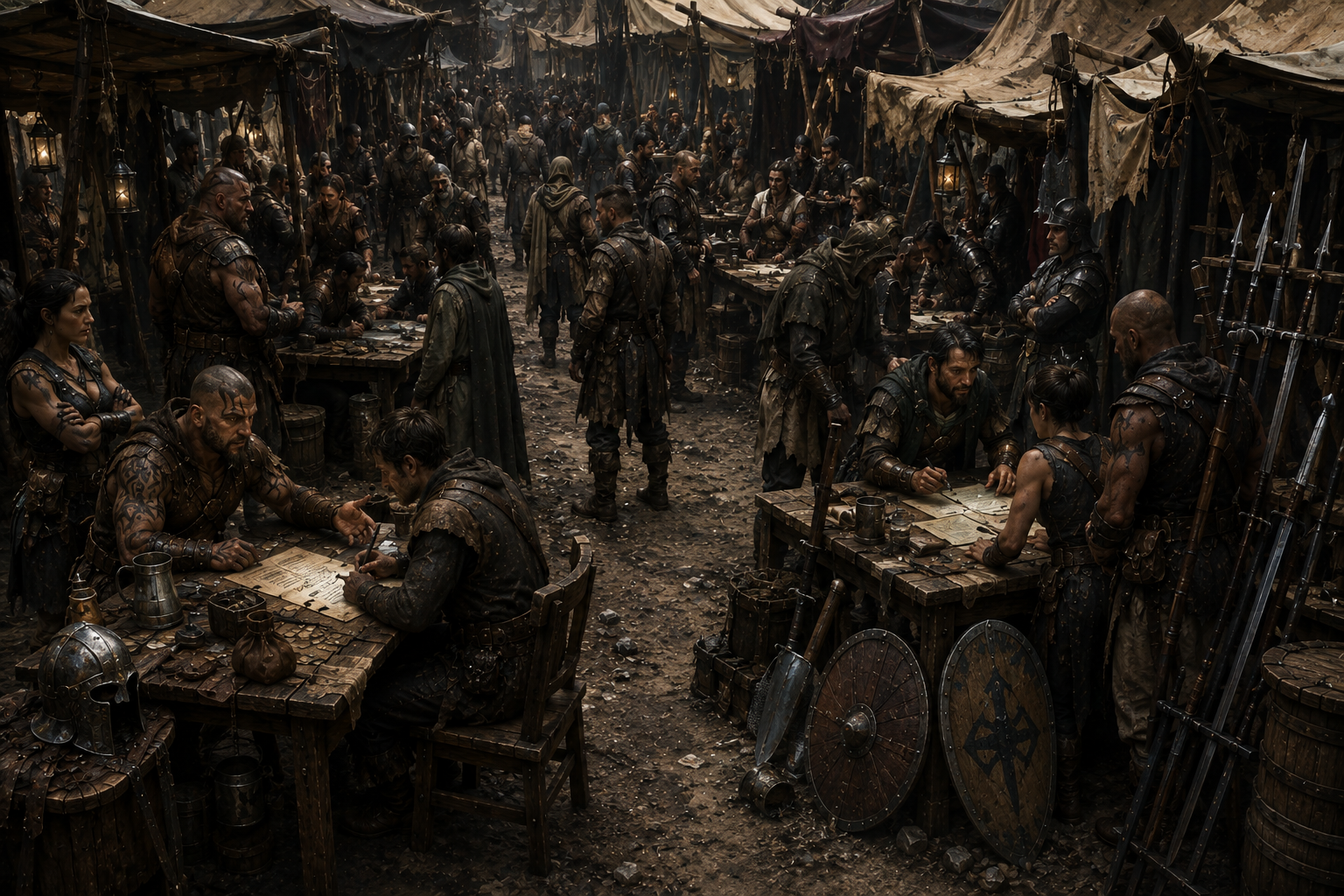
Blackmarket Row

A notorious stretch of market street on the southern trade routes of Keynew where mercenary contracts, debt-service agreements, bodyguard retainers, and dangerous work change hands openly. It is not legally considered a slave market, but many across Keynew argue that the difference can become uncomfortably thin.

Blackmarket Row of Abadonya
Landmark Overview Keynew • Koin Trade Roads

A Market for Contracts, Not People

Blackmarket Row is a long, crowded lane of hiring tables, contract booths, recruiters, brokers, quartermasters, and mercenary companies. The Row's defenders insist that nobody is legally bought or sold here. Instead, contracts are purchased, transferred, settled, or assumed.

In practice, that distinction is not always comforting. Some contracts are voluntary and lucrative. Others are signed under debt, desperation, legal pressure, or circumstances that leave the signer with few realistic alternatives.

Mercenary Trade Hiring & Transfer

Soldiers for Coin

Most business on Blackmarket Row is straightforward mercenary hiring. Caravan masters recruit guards, nobles seek household soldiers, merchants hire escorts, and adventuring companies replace lost members.

Experienced mercenaries negotiate wages, equipment, hazard pay, length of service, and rights to loot. Newer fighters are far more vulnerable to unfavorable terms, especially when they arrive hungry or already in debt.

Indentured Service The Legal Gray Line

Debt Made Into Years

The most controversial part of Blackmarket Row is the trade in indenture contracts. A person may agree to serve for a defined period in exchange for payment of debt, legal protection, training, passage, or other compensation.

These arrangements are lawful only when the terms are written, the duration is finite, and the contract does not grant the holder permanent ownership of the person. In theory, an indentured servant remains legally free.

Critics argue that this protection means little when debtors cannot read the contract, have no money for legal help, or are threatened with prison, starvation, or ruin if they refuse.

Contract Brokers Middlemen of the Row

Ink Can Be More Dangerous Than Steel

Brokers make the Row function. They match employers with mercenaries, verify signatures, witness agreements, transfer debt-service contracts, and take a percentage from nearly every deal.

Reputable brokers explain terms clearly and maintain copies of contracts. Less reputable ones bury penalties, extend service through fees, or arrange transfers to employers the signer never expected to serve.

The Hiring Boards Visible Face of the Row

Work Posted in Public

Large timber boards line parts of Blackmarket Row, covered in wax-sealed notices and nailed contracts. Jobs range from ordinary caravan protection to monster hunting, private war work, debt recovery, and assignments vague enough to make experienced mercenaries walk away.

Some notices list exact wages and duration. Others simply name a broker and promise “terms upon interview.” Those are generally considered the dangerous ones.

Notable Features Along the Row

Places Known to Regulars

The Iron Table: A heavy public table where larger mercenary companies negotiate group contracts.

The Red Ledger Booth: A contract-copying stall famous for keeping duplicate records of every agreement it witnesses.

The Free Bell: A suspended brass bell traditionally rung when an indentured contract reaches its lawful end.

The Recruiter’s Steps: A broad set of stone steps where independent fighters stand when seeking immediate work.

The Surety Cage: Despite the name, it is not a prison. It is a barred records booth where disputed contracts are held until reviewed.

Regional Controversy How Keynew Sees the Row

Legal Does Not Mean Respected

Some Keynew merchants defend Blackmarket Row as necessary. They argue that it provides work, resolves debt, gives inexperienced fighters access to training, and supplies guards for dangerous trade routes.

Others regard the Row as a stain on the region. Clergy, travelers, and some civic officials argue that a contract signed under desperation is only technically voluntary.

The strongest criticism comes when contracts are transferred from one holder to another. Even when lawful, watching a person's remaining years of service change hands for coin makes the Row look far more like the markets its defenders insist it is not.

Rules of the Row Unwritten & Written Customs

Everything Must Have Ink

Blackmarket Row has one principle it takes seriously: if a service obligation cannot be produced in writing, it is not recognized as legitimate business.

Employers are expected to honor duration, pay, rations, and release conditions exactly as written. Mercenaries are expected to complete lawful service. Disputes are often settled by brokers, hired arbiters, or whoever has enough influence to force both parties back to the table.

Open kidnapping or permanent ownership is forbidden. Whether every broker obeys that rule is another question.

Rumors & Whispers What People Say Quietly

Where the Fine Line Blurs

Some say certain brokers deliberately loan money to desperate fighters, then place the resulting debt contract with employers who already paid the broker in advance.

Others claim contracts exist with service terms written in hidden ink, visible only after the signer has already agreed.

A darker rumor says a few people listed as “transferred mercenaries” have vanished from the public ledgers entirely, suggesting someone is using the Row to disguise something the law would never permit openly.

Campaign Hooks Adventure Seeds

Reasons to Visit Blackmarket Row

The Impossible Contract: A mercenary asks the party to prove that the terms of an indenture were altered after signing.

The Silent Bell: The Free Bell is scheduled to ring for a servant whose term has ended, but the contract holder refuses release.

The Missing Company: An entire mercenary unit is transferred to a new employer and disappears before reaching its destination.

The Bought Debt: Someone purchases the debt contract of a person the party knows and refuses to reveal why.

<