The Stone Choir

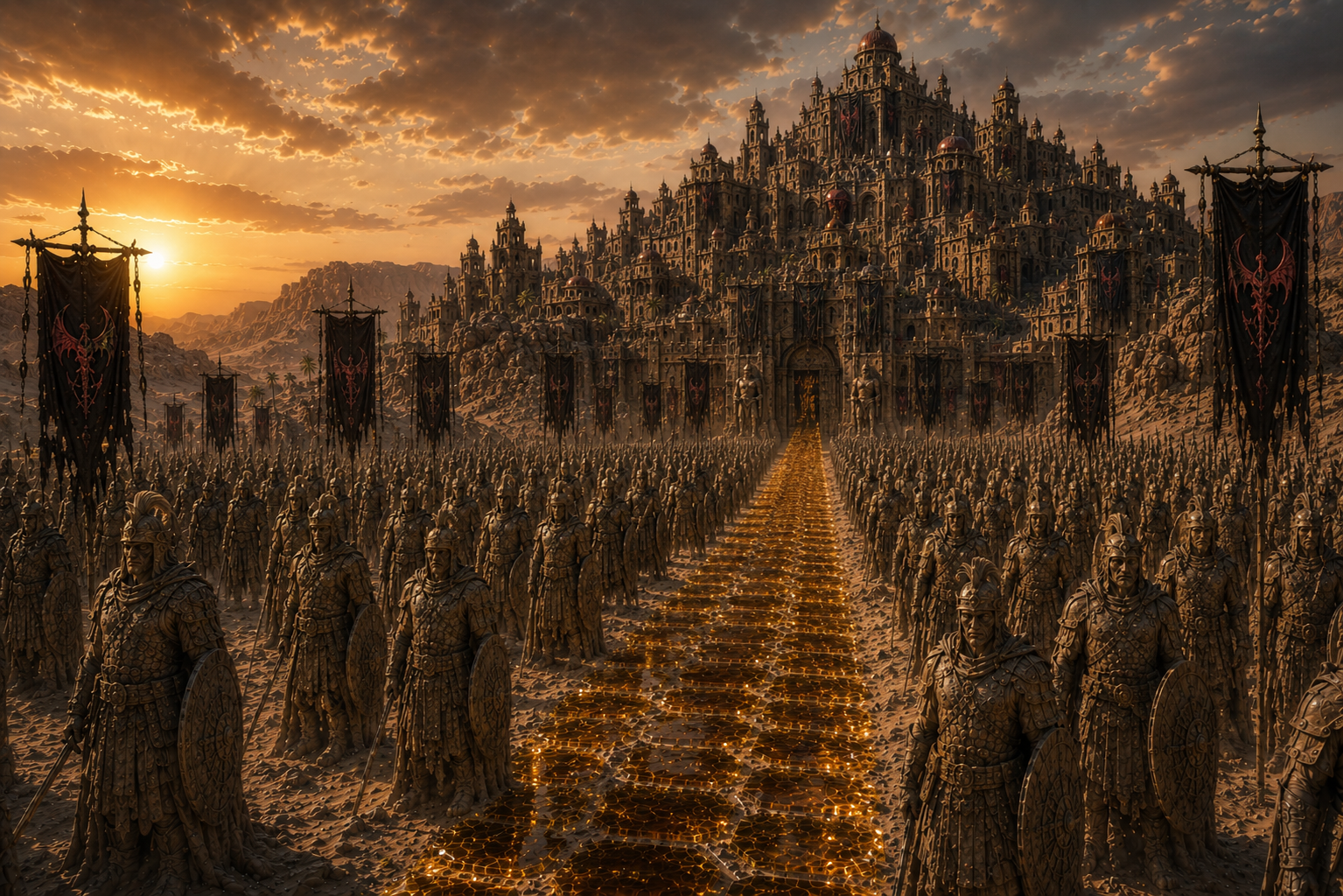
Across a lonely stretch of Petra's desert stands an army that has not marched in living memory. Thousands of stone soldiers face the same distant horizon, weapons lowered, ranks unbroken, and faces worn smooth by centuries of wind. Locals call them the Stone Choir—because when the desert wind passes through their ranks, the statues seem to hum.

The Stone Choir of Abadonya
A Silent Army in the Sand Petra Landmark

What Travelers See

The Stone Choir is not a ruin in the usual sense. There are no collapsed walls, buried streets, or abandoned houses. There is only an army. Row after row of life-sized warriors stand half-buried in the pale sand, arranged with military precision across a shallow basin. Some carry spears, some broad shields, and others long-bladed weapons whose designs do not match any modern Petra arsenal.

No two statues are completely identical. Their armor varies slightly, their faces bear different features, and weathered standards rise above several formations. This has led many scholars to argue that the figures were not carved as decoration. They were meant to represent specific soldiers—or, according to the oldest stories, they are the soldiers.

The Last Order Local Tradition

“They Are Waiting, Not Sleeping.”

Petra's desert folk tell the same warning in dozens of different ways: the Stone Choir was never defeated. It was stopped. The army was given an order long ago, and something prevented it from carrying that command to completion. Whether the soldiers were petrified by magic, transformed willingly, or created from stone in the first place is unknown.

The common belief is simple and unsettling: one day the statues will awaken and finish their last orders. No one agrees on what those orders were. Some say they were marching to defend Petra. Others insist they were meant to destroy a city whose name has been erased from history. A darker version claims the army was ordered to kill everyone who remained in the desert after a forgotten war.

Among the Ranks Traveler's Guide

A Place Locals Treat Carefully

Travelers are permitted to pass near the Stone Choir, but most Petra guides refuse to lead anyone directly through the formations. The statues are treated with the wary respect given to sleeping predators. Touching them is discouraged. Climbing them is considered foolish. Removing weapons, carved insignia, or pieces of broken stone is viewed as an invitation to disaster.

The sand between the ranks is strangely firm and rarely forms deep drifts. Even after violent storms, the central paths reappear within a day or two. Small stone markers stand at the edge of the basin, placed there by generations of travelers who preferred to leave offerings rather than questions.

Common offerings include a cup of water, a copper coin, a broken arrow, or a strip of red cloth tied to a spear shaft.

The Choir's Song Natural Phenomenon

When the Wind Changes

The landmark earned its name from the sound made when strong desert winds sweep across the army. Air passes through hollow spaces in ancient helmets, cracked shields, and narrow gaps between the soldiers, producing a low layered tone that can be heard miles away. Most days it resembles distant chanting. On rare nights, however, travelers swear that the sound changes into distinct rhythms—as if thousands of stone throats were drawing breath together.

Caravan masters consider a sudden silence more ominous than the singing. If the wind is blowing and the Choir makes no sound, many camps pack immediately and travel until dawn.

Signs That Trouble Travelers Observed Oddities

Things People Claim to Have Seen

Most visitors see nothing more than weathered statues. Yet stories persist of small changes that are difficult to dismiss. A shield that faced east the previous evening is found facing south by morning. Fresh footprints appear between ranks despite an empty horizon. Statues uncovered by a sandstorm are sometimes found in places where older maps show nothing at all.

The most disturbing tales concern the officers near the center of the formation. Their stone eyes are carved open, unlike the closed or lowered eyes of most soldiers. Travelers who sleep within sight of them sometimes dream of horns sounding beneath the earth and wake convinced that they have forgotten an important command.

Zae'Halem and the Stone Choir Modern Petra

The Queen's Interest

Since the rise of Zae'Halem, patrols have become more common along routes near the Stone Choir. The Queen's officials publicly describe this as protection for caravans and a measure against relic thieves. Few locals believe that is the entire reason. Surveyors have been seen measuring the formations, copying symbols from the officers' armor, and marking locations on sealed maps.

Soldiers of Zae'Halem do not camp inside the basin. Whatever their Queen may want from the Stone Choir, her troops appear to share the desert's old superstition: watch the army, count the statues, and never be present when they receive their next command.

What Travelers Whisper Roadside Rumors

Stories Heard Across Petra

• There are more statues in the basin every year, but no one has ever seen a new one arrive.

• One of the officers carries a stone tablet that supposedly contains the army's final command.

• A merchant once broke a stone soldier's hand for a souvenir. His caravan vanished before reaching the Glass Road.

• During certain moonless nights, the entire army is said to face Zae'Halem.

• Deep beneath the central ranks lies something the army was ordered to guard—or something it was ordered to kill.

• The first person to speak the original command aloud will become the Stone Choir's new general.

Mood for Players Campaign Setting

The Army That Has Not Finished

The Stone Choir should feel ancient, disciplined, and patient. It is not a battlefield frozen at the moment of defeat. It is an army standing at attention centuries after everyone who might remember its purpose has died. Nothing is happening—and that is exactly what makes the place unsettling.

The question is not whether the Stone Choir can march. It is what happens when someone finally tells it to.