The Bleeding Basin

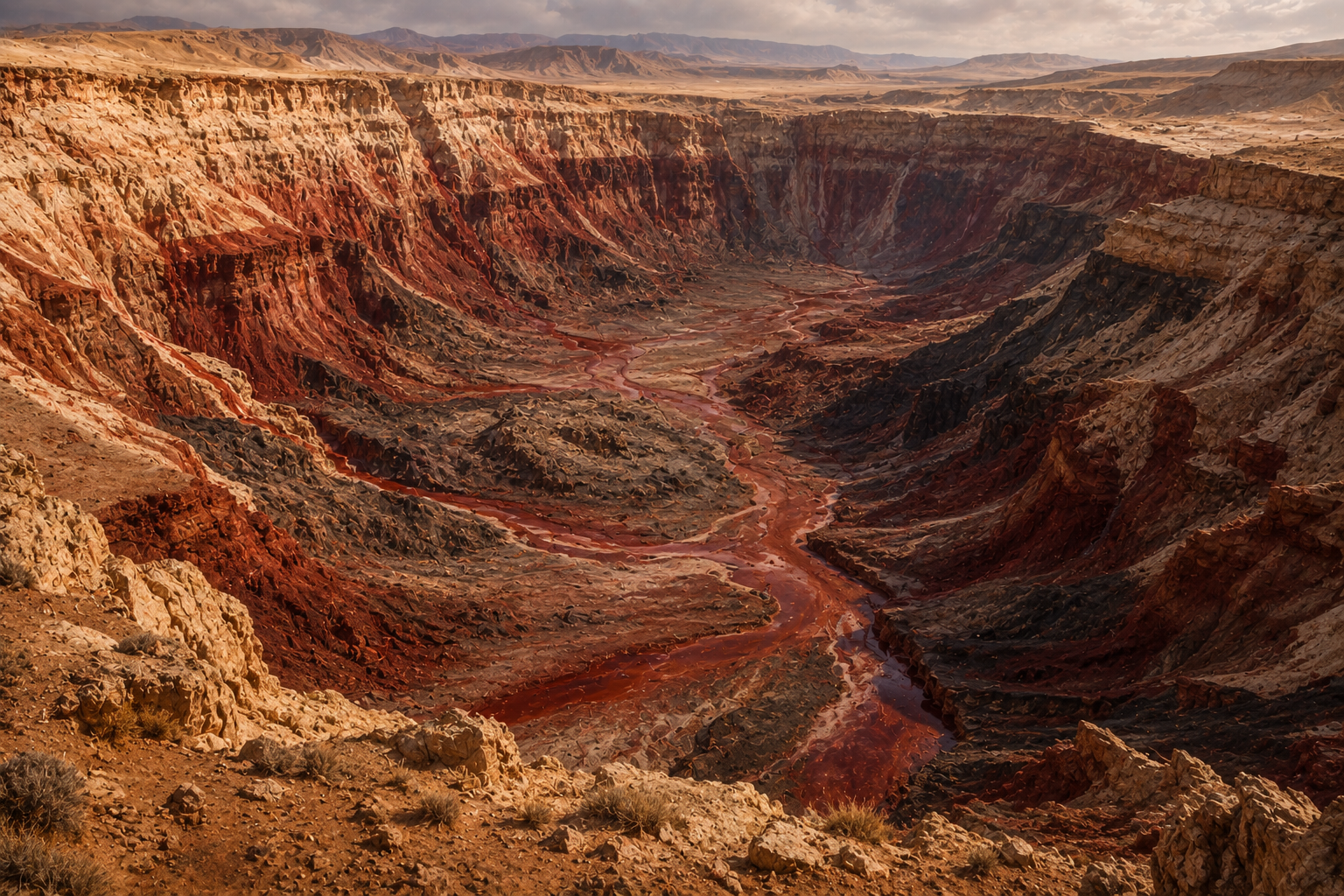
A vast, sunken hollow of red-stained earth in the deserts of Petra, the Bleeding Basin is one of the region's most unsettling natural landmarks. From a distance it resembles an enormous wound opened in the desert, its slopes streaked crimson and its lowest flats darkened by mineral-rich seepage that locals simply call the blood of the basin.

The Bleeding Basin of Abadonya
A Wound in the Desert Petra Landmark

First Sight

Travelers usually see the basin long before they reach its rim. The golden desert suddenly breaks into bands of rust-red stone, clay, and blackened ridges. Beyond them, the land drops away into a broad depression several miles across. The walls are layered like exposed flesh: pale sandstone, iron-red sediment, and dark veins of stone running toward the basin floor.

After rare rains, thin streams spill down the slopes. The water gathers the red minerals of the cliffs until it looks disturbingly like blood flowing through hundreds of shallow cuts. The sight is responsible for the landmark's name—and for many of its oldest stories.

What Travelers Know Common Knowledge

The Basin Is Not Empty

The Bleeding Basin is not considered impassable, but few caravans willingly descend into it. Trails along the rim are safer, easier to follow, and far less likely to leave travelers trapped when the weather changes. Those who enter usually do so because they are hunting something, hiding from someone, or trying to avoid the taxes and patrols of the better-traveled roads.

The lower basin contains cracked flats, narrow ravines, isolated stone pillars, and shallow pools of bitter red water. Some pools dry into brilliant crimson salt beds. Others remain wet even through the worst heat, though locals strongly warn outsiders not to drink from them.

Landmarks Within the Basin Known Features

The Red Steps

A natural sequence of broad stone shelves descends from the northern rim. It is the easiest known route into the basin and, for that reason, the place where old campfires, discarded rope, broken wagon parts, and warning cairns are most often found.

The Weeping Wall

Along the eastern face, red mineral water seeps constantly from hairline cracks in the rock. The wall appears to sweat in the heat. At sunset, the entire cliff shines dark crimson.

The Black Teeth

A cluster of jagged basalt spires rises from the basin floor. They provide rare shade during the day, but Petra travelers seldom camp beneath them. Wind moving through the formations produces low, uneven tones that can be heard across the flats after dark.

The Dry Heart

Near the center of the basin lies a nearly perfect circular patch of pale, cracked ground where none of the red seepage seems to flow. Travelers have stacked small stone markers around its edge for generations, though no one agrees on who began the practice.

Hazards of the Basin Traveler Warning

Heat, Flood, and Bad Ground

Heat gathers in the depression and can become worse than on the open dunes. Shade is scarce, distances are deceptive, and the red flats become soft mud after rainfall. Sudden storms in distant parts of Petra can also send water racing through the basin's ravines with little warning.

The colored crust around some pools is dangerously thin. Animals have been known to break through and become trapped in mineral mud beneath the surface. Experienced guides test suspicious ground with poles and avoid following hoofprints too closely; an animal that crossed safely in the cool morning may have weakened the crust for whoever follows later.

Zae'Halem and the Basin Regional Influence

Beyond the Queen's Preferred Roads

Zae'Halem does not maintain the basin as a formal trade route. The Queen's officials strongly encourage merchants to remain on monitored roads where cargo can be inspected and taxed. Because of this, anyone found emerging from the Bleeding Basin with a heavily laden caravan is likely to attract questions from royal patrols.

This has not stopped smugglers, fugitives, prospectors, and stubborn caravan masters from attempting the crossing. The basin is dangerous, but danger and taxation are measured differently by desperate people.

Stories Told at the Rim Rumors & Folklore

What Locals Whisper

No single story explains the Bleeding Basin. Some claim it formed where an ancient creature was slain and buried beneath the desert. Others insist the red water is merely iron and salt, and that frightened travelers invented the rest. A few priests describe the basin as a scar left from an age when the land itself could be wounded.

Travelers also speak of red lights moving along the lower flats after midnight, footprints that end at the edge of dry stone, and voices carrying from the Black Teeth when there is no one else nearby. Prospectors occasionally return with unusually heavy pieces of dark red ore—but rarely reveal where they found them.

The Bleeding Basin at a Glance Player Briefing

Mood & Character

The Bleeding Basin is exposed, oppressive, beautiful, and wrong-looking. It is a place where the desert seems less dead than wounded. The red slopes are visible for miles, the wind carries strange sounds across the open floor, and every safe route back out feels farther away once you descend.

For travelers, the lesson is simple: the basin may shorten a journey or hide your passage—but Petra rarely gives such advantages without demanding something in return.