Dhampirs of Abadonya

Dhampirs are living mortals whose blood carries a powerful undead legacy. In Abadonya they are most strongly associated with Oriander, where old island houses, hidden coastal estates, night markets, and generations of secretive bloodlines have allowed them to exist among ordinary society without forming a single nation of their own. They are neither fully living in the ordinary sense nor undead, and their unusual nature shapes both how they are treated and how they see themselves.

Dhampir of Abadonya
Dhampirs in AbadonyaNight-Touched Folk of Oriander

Living Between Two Natures

Dhampirs appear most often in Oriander's larger islands and coastal settlements, especially in places where old families have maintained private estates, hidden histories, and long traditions of avoiding unwanted attention.

A Dhampir may be born into an otherwise ordinary mortal family, and the bloodline can remain dormant for generations before surfacing again.

They are living beings, but positive and negative energy affect them differently from most mortals. This makes ordinary healing magic complicated and forces many Dhampirs to learn early how their bodies respond to injury.

AppearanceGraceful, Pale & Unsettling

Marked by the Night

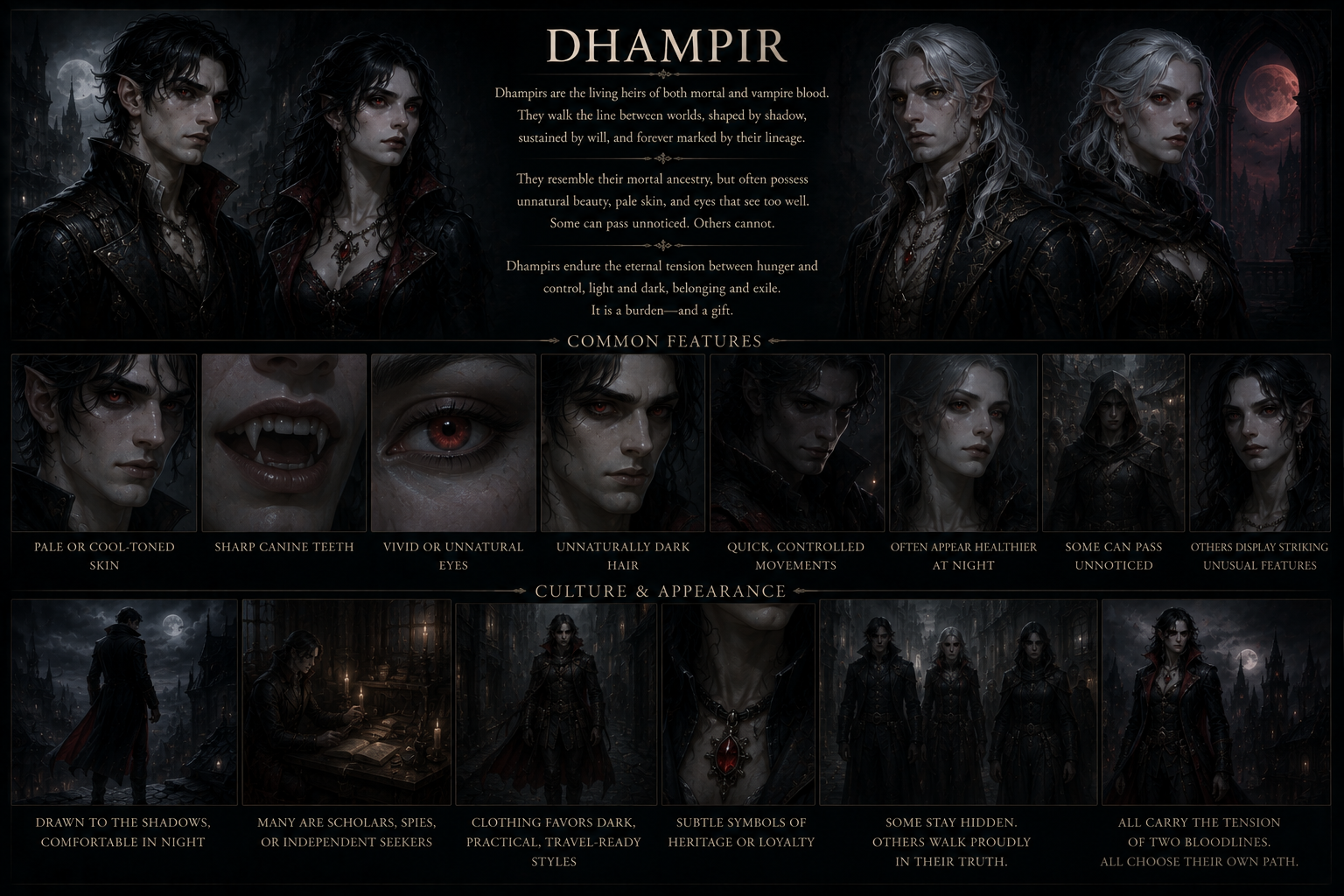
Dhampirs usually resemble unusually pale, striking members of their mortal ancestry. Their movements tend to be quick and controlled, and many possess an unnaturally intense gaze.

Common traits include pale or cool-toned skin, sharp canine teeth, vivid eyes, unusually dark hair, and a tendency to look healthier at night than beneath harsh daylight.

Not every Dhampir is immediately recognizable. Some can pass unnoticed in a crowd, while others display enough unusual features that strangers quickly suspect something uncommon in their blood.

Oriander Night HousesOld Families and Hidden Lineages

Bloodlines Behind Closed Doors

Oriander Dhampirs rarely gather into public communities large enough to be called towns or districts. Instead, they are scattered among old houses, private estates, secluded island families, and urban neighborhoods where night activity is normal.

Some families openly acknowledge their heritage. Others conceal it completely, teaching children how to avoid unnecessary attention and how to explain away unusual habits.

Night markets, dock districts, theaters, private salons, and late-running trade houses are natural places for Dhampirs to work because their sensitivity to bright light matters less after sunset.

A few influential families have maintained uninterrupted Dhampir lineages for centuries and possess records of Oriander history unavailable in public archives.

Life and DeathA Different Relationship with Undeath

Neither Corpse Nor Ordinary Mortal

Dhampirs possess an instinctive awareness of the undead and an unusual resistance to many effects associated with them.

This can create complicated relationships with priests, healers, necromancers, and undead hunters. Some see Dhampirs as valuable allies against the dead; others regard their very existence with suspicion.

Many Dhampirs develop strong opinions about undeath precisely because it is so close to their own nature. Some hunt undead relentlessly. Others study it in the hope of understanding themselves.

Their heritage does not force a particular attitude toward vampires or other undead creatures.

Blood & Self-ControlDesire Is Not Obligation

The Hunger Some Never Discuss

Some Dhampirs experience a persistent attraction to blood even though they do not require it to survive.

Oriander families handle this subject differently. Some speak of it openly and teach discipline. Others treat it as shameful and refuse to acknowledge it at all.

Most Dhampirs never feed on another person. Those who do must still answer for the choices they make, particularly when another intelligent creature is harmed.

Among responsible Dhampir communities, self-control is respected far more than indulging every inherited impulse.

Faith & OutlookLiving Under a Long Shadow

What the Blood Means Is a Choice

Dhampirs often develop strong personal beliefs because their existence raises difficult questions about life, death, inheritance, and free will.

In Abadonya, some are drawn toward Marius because of his authority over death and the boundaries surrounding it. Others deliberately turn toward Seraphim as a rejection of the darkness associated with their blood.

Rivera also attracts Oriander Dhampirs who identify more strongly with island and coastal culture than with supernatural ancestry.

Dhampirs may follow any alignment or deity. Their lineage determines unusual traits, not destiny.

Pathfinder 1e RulesRules Unchanged

Standard Pathfinder 1e Racial Traits

Ability Score Modifiers: Dhampirs gain +2 Dexterity, +2 Charisma, and –2 Constitution.

Type: Dhampirs are humanoids with the dhampir subtype.

Size: Dhampirs are Medium creatures and have no bonuses or penalties due to size.

Base Speed: Dhampirs have a base speed of 30 feet.

Languages: Dhampirs begin play speaking Common. Dhampirs with high Intelligence scores can choose any bonus language except secret languages such as Druidic.

Undead Resistance: Dhampirs gain a +2 racial bonus on saving throws against disease and mind-affecting effects.

Resist Level Drain (Ex): Dhampirs take no penalties from energy drain effects, though they can still be killed if they accumulate more negative levels than they have Hit Dice. After 24 hours, any negative levels are removed without requiring an additional saving throw.

Manipulative: Dhampirs gain a +2 racial bonus on Bluff and Perception checks.

Spell-Like Ability: Dhampirs can use detect undead three times per day. Caster level equals the Dhampir's class level.

Darkvision: Dhampirs have darkvision 60 feet.

Low-Light Vision: Dhampirs can see twice as far as humans in conditions of dim light.

Light Sensitivity: Dhampirs are dazzled in areas of bright sunlight or within the radius of a daylight spell.

Negative Energy Affinity: Though living creatures, Dhampirs react to positive and negative energy as if undead. Positive energy harms them, while negative energy heals them.

Race Points: 11 RP.

These are the Pathfinder 1e racial mechanics used for Dhampir characters in Abadonya.
Dhampir Traits & FeatsPathfinder 1e Character Options

Selected Dhampir Options

Born in the Light: A Dhampir accustomed to daylight gains a +2 trait bonus on checks and saves affected by the Endurance feat and ignores the Perception penalty normally caused when Light Sensitivity leaves the character dazzled.

Half-Forgotten Secrets: Gain a +1 trait bonus on two Knowledge skills of your choice, and one of those skills becomes a class skill.

Undead Slayer: Gain a +1 trait bonus on attack and damage rolls against undead creatures.

Unusual Origin: A qualifying 1st-level Dhampir can gain a natural bite attack dealing 1d4 damage and can cause additional bleed damage once per day after a successful bite.

These are optional Pathfinder 1e character choices rather than additions to the standard racial package.

Dhampirs of OrianderAncestral Homeland & Major Population

The Islands After Sunset

Oriander is the principal homeland associated with Dhampirs in Abadonya. They are especially common around old coastal settlements, island estates, major ports, and places where night commerce is socially normal.

Dhampirs are not a majority population anywhere in the region. Their numbers remain scattered enough that many residents know of them without personally knowing one.

Those who prefer privacy can disappear easily among Oriander's many islands, hidden coves, secluded estates, and remote communities.

AdventurersThose Who Refuse to Be Defined

A Life Chosen Deliberately

Dhampirs often become adventurers because ordinary communities can be uncomfortable places for someone touched so strongly by undeath.

Rogues, investigators, rangers, fighters, bards, oracles, inquisitors, and other agile or socially adept classes are common, though Dhampirs can pursue any class.

An Oriander Dhampir might hunt undead predators, investigate the origin of an old family bloodline, protect a settlement that distrusts them, or leave the islands simply to build a life judged by deeds instead of ancestry.

Race IndexAbadonya Archive

Return to the Races of Abadonya index to browse other ancestries.