Elves of Abadonya

Elves are one of Abadonya's oldest and most enduring peoples, with their deepest roots in the ancient forests of Eirlyn and long-established populations in Keynew. Their principal capital is Syl-Vaelar, a great elven city whose traditions of scholarship, magic, diplomacy, and stewardship influence elven communities far beyond Eirlyn.

Elf of Abadonya
Elves in AbadonyaAncient People of Eirlyn & Keynew

A People of Deep Memory

Elven history in Abadonya stretches across eras that many younger peoples remember only through legend. Their long lives encourage careful recordkeeping, patient planning, and a cultural tendency to think in generations rather than seasons.

Long before the Elemental War, the elves conquered and controlled much of the central lands of the known world—the vast territory that is now called Eirlyn. That ancient dominion remains an important part of elven identity and historical memory. An old saying, still repeated with pride among many elves, declares: “We control the center of the world.”

Eirlyn remains the spiritual and cultural heartland of the elves, while Keynew contains old elven communities, border settlements, diplomatic enclaves, and families whose histories have become intertwined with the region over centuries.

Elves are often associated with magic and wilderness tradition, but their society includes soldiers, artisans, merchants, priests, scholars, diplomats, farmers, hunters, explorers, and countless other callings.

AppearanceGrace, Longevity & Variation

Slender and Distinctive

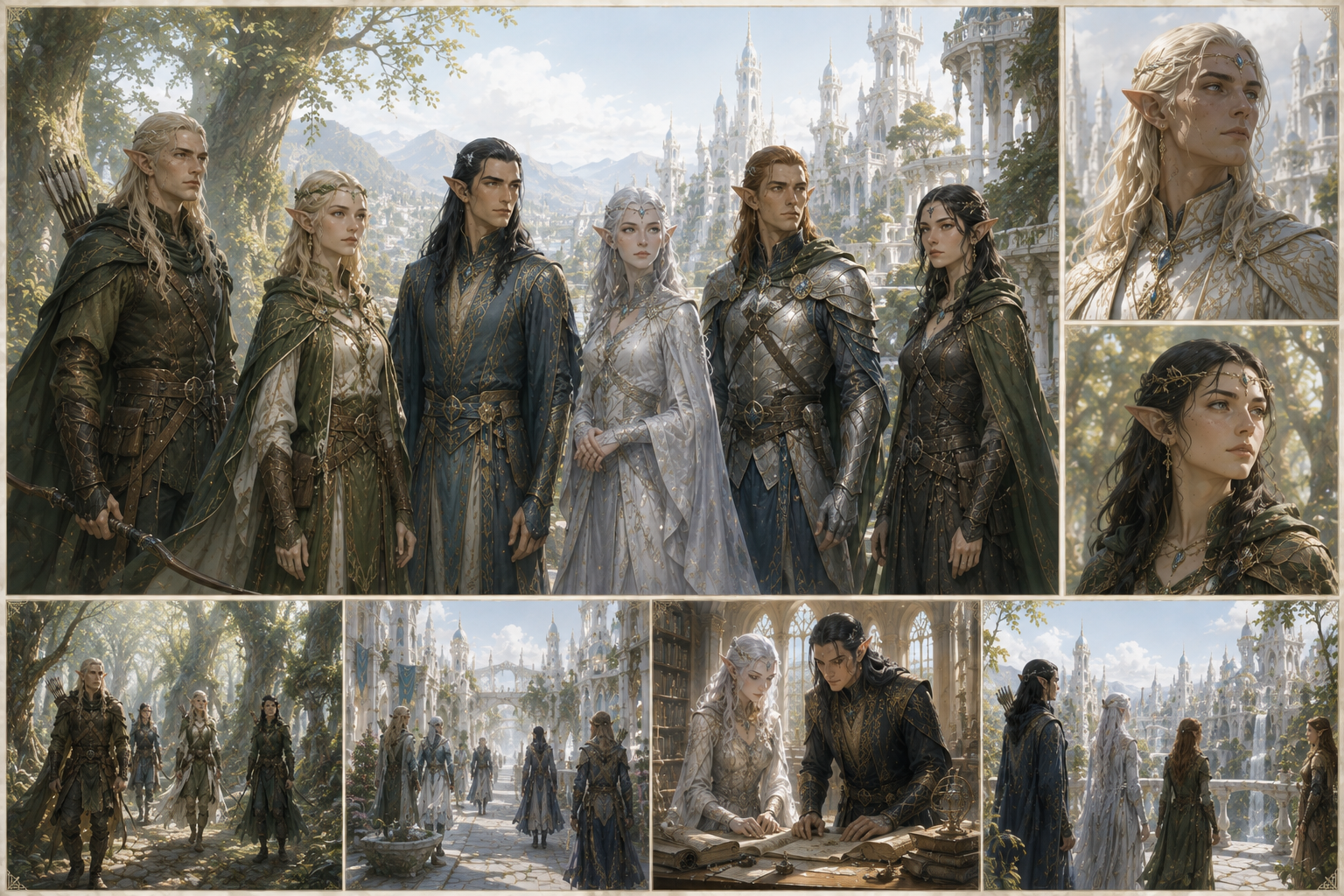
Elves are generally tall and slender, with fine features and sharply pointed ears. Their builds tend toward grace and agility rather than heavy musculature.

Hair and eye color vary widely between families. Pale blond, silver, black, brown, auburn, and other natural shades are common, while some ancient bloodlines display unusual colors associated with magic, woodland ancestry, or family tradition.

Clothing differs by community. Forest-dwelling elves often favor layered natural fabrics, leather, cloaks, and practical gear suited to woodland travel, while residents of Syl-Vaelar may wear elegant robes, fitted armor, ceremonial garments, or insignia tied to house, profession, school, or civic office.

Syl-VaelarPrincipal Capital of the Elves

The Elven Capital

Syl-Vaelar is the principal capital of the elves of Abadonya and one of the most important centers of elven culture, governance, magical study, and historical memory.

Its influence reaches beyond its own walls. Elven settlements across Eirlyn look to Syl-Vaelar for scholarship, diplomacy, cultural authority, and leadership in matters affecting the wider elven people.

Families from Keynew also maintain ties to the capital through marriage, study, trade, religious observance, military service, and political representation.

Eirlyn HeritageThe Ancient Forest Homeland

Children of the Eternal Woods

Eirlyn is the oldest and strongest elven homeland in Abadonya. Its deep forests, old roads, sacred groves, living fortifications, and hidden settlements have shaped elven civilization for countless generations.

Many Eirlyn elves view stewardship as a sacred responsibility. Forests, ruins, rivers, old battlefields, and ancestral places are not treated as empty land but as inheritances entrusted to the living.

Elven settlements in Eirlyn tend to value privacy and controlled access. Outsiders are not necessarily treated as enemies, but visitors are expected to respect boundaries, local customs, and the authority of those who protect the forest.

Keynew CommunitiesOld Roots Beyond Eirlyn

Elves of the Western Lands

Keynew also contains substantial elven populations. Some communities predate modern human settlements, while others arose from trade, diplomatic missions, military cooperation, family migration, or the slow expansion of Eirlyn's influence into neighboring lands.

Keynew elves often live closer to humans, dwarves, half-elves, and other peoples than their Eirlyn kin. This has produced communities that are usually more accustomed to mixed settlements and cross-cultural politics.

Despite these differences, many still maintain strong cultural connections to Eirlyn and Syl-Vaelar.

Magic & ScholarshipCenturies of Study

Knowledge Built Over Lifetimes

Elves have a strong reputation for arcane study, and their long lives allow dedicated scholars to spend decades mastering a single magical discipline, language, craft, or field of history.

Wizardry is particularly respected, though elven magical traditions also include druids, witches, magi, arcanists, clerics, oracles, and other spellcasters.

Not every elf pursues magic. Martial traditions remain equally old, especially archery, swordsmanship, scouting, and wilderness warfare.

Society & OutlookPatience, Memory & Responsibility

Living with Long Consequences

Elven decisions are often shaped by longevity. A political mistake, damaged alliance, or ruined grove may remain personally remembered by the same individuals centuries later.

This can make elves appear cautious or slow to act, but when they commit to a cause they may sustain it for generations. Promises, grudges, alliances, and duties can all outlive shorter-lived rulers and kingdoms.

Individual elves vary widely. Some embrace tradition, while others deliberately reject the expectations of old families and seek lives far beyond elven lands.

Faith & TraditionNature, Magic & Memory

Many Paths Beneath the Trees

Elven faith in Abadonya is diverse. Trentula appeals strongly to communities concerned with forests and the natural world, while Rashtala attracts arcane scholars and magical institutions.

Mandella is respected by historians, archivists, messengers, and those dedicated to preserving truth and memory. Other elves follow Seraphim, Rivera, Namir, Marius, Liliana, or regional and family traditions.

Elves may follow any alignment or deity. Their culture strongly influences them, but does not dictate personal belief.

Pathfinder 1e RulesCore Elf Mechanics

Standard Pathfinder 1e Racial Traits

Ability Score Modifiers: Elves gain +2 Dexterity, +2 Intelligence, and –2 Constitution.

Type: Elves are humanoids with the elf subtype.

Size: Elves are Medium creatures and have no bonuses or penalties due to size.

Base Speed: Elves have a base speed of 30 feet.

Languages: Elves begin play speaking Common and Elven. Elves with high Intelligence scores can choose Celestial, Draconic, Gnoll, Gnome, Goblin, Orc, and Sylvan as bonus languages.

Elven Immunities: Elves are immune to magic sleep effects and gain a +2 racial saving throw bonus against enchantment spells and effects.

Keen Senses: Elves gain a +2 racial bonus on Perception checks.

Elven Magic: Elves gain a +2 racial bonus on caster level checks made to overcome spell resistance and a +2 racial bonus on Spellcraft checks made to identify the properties of magic items.

Weapon Familiarity: Elves are proficient with longbows, composite longbows, longswords, rapiers, shortbows, and composite shortbows, and treat any weapon with “elven” in its name as a martial weapon.

Low-Light Vision: Elves can see twice as far as humans in conditions of dim light.

These are the standard Pathfinder 1e elf racial mechanics used for elf characters in Abadonya.

Alternate Racial TraitsPathfinder 1e Options

Selected Alternate Racial Traits

Ageless Patience: Gain a +2 racial bonus when taking 20 on skill checks. This replaces Elven Magic and Keen Senses.

Arcane Focus: Gain a +2 racial bonus on concentration checks made to cast arcane spells defensively. This replaces Weapon Familiarity.

Blightborn: Gain bonuses on saving throws against necromancy, curses, and effects that remove temporary negative levels. This replaces Elven Immunities.

Desert Runner: Gain a +4 racial bonus on Constitution checks and Fortitude saves against fatigue, exhaustion, forced marches, starvation, thirst, and harsh environments. This replaces Elven Magic.

Dreamspeaker: Improves the saving throw DCs of divination spells and sleep effects, and exceptionally charismatic elves can gain a dream-related spell-like ability. This replaces Elven Immunities.

Lightbringer: Gain resistance to light-based blindness and dazzle effects, improve light-based magic, and potentially use light as a spell-like ability. This replaces Elven Immunities and Elven Magic.

Loremasters: Gain racial bonuses on Knowledge (history), Knowledge (local), and Spellcraft checks. This replaces Elven Magic and Keen Senses.

Silent Hunter: Reduce movement penalties to Stealth and retain the ability to attempt Stealth while running. This replaces Elven Magic.

Woodcraft: Gain bonuses on Knowledge (nature) and Survival checks, improving further in forest terrain. This replaces Elven Magic.

Elf AdventurersBeyond Syl-Vaelar

Centuries Still Begin with a First Journey

Elf adventurers leave home for scholarship, diplomacy, war, exploration, duty, personal ambition, or simple curiosity. Some are sent from Syl-Vaelar on formal missions, while others depart against the wishes of family or tradition.

Wizards, magi, rangers, rogues, fighters, druids, arcanists, witches, clerics, and other classes all fit naturally, though elves can pursue any class.

An elf from Eirlyn might investigate a disturbance in an ancient grove, recover a lost family relic, serve as an envoy in Keynew, pursue arcane research, or travel beyond elven lands to understand how the rest of Abadonya is changing.

Race IndexAbadonya Archive

Return to the Races of Abadonya index to browse other ancestries.