Ifrits of Abadonya

Ifrits are fire-touched mortals whose blood carries elemental heat. In Abadonya their ancestral heartland and greatest population is found in Petra's Glass Wastes, where fused deserts, volcanic scars, sun-beaten caravan roads, and forge settlements have shaped generations of restless, resilient families. Their affinity for flame makes them natural smiths, scouts, travelers, performers, and spellcasters in a region where heat is both danger and livelihood.

Ifrit of Abadonya
Ifrits in AbadonyaFire-Touched Folk of Petra

Born Where Heat Shapes Everything

Ifrit families are most common in Petra's hotter settlements, especially around forge districts, caravan towns, volcanic scars, geothermal vents, and communities bordering the Glass Wastes.

Some bloodlines trace their elemental heritage to old contact with powerful beings of fire, while others believe generations of exposure to supernatural heat and elemental magic changed mortal families over time.

Ifrits rarely form large nations of their own. Most belong to Petra's existing settlements, clans, caravan companies, smithing houses, and traveling communities.

AppearanceHeat Made Visible

Brass Skin, Ember Eyes, and Living Flame

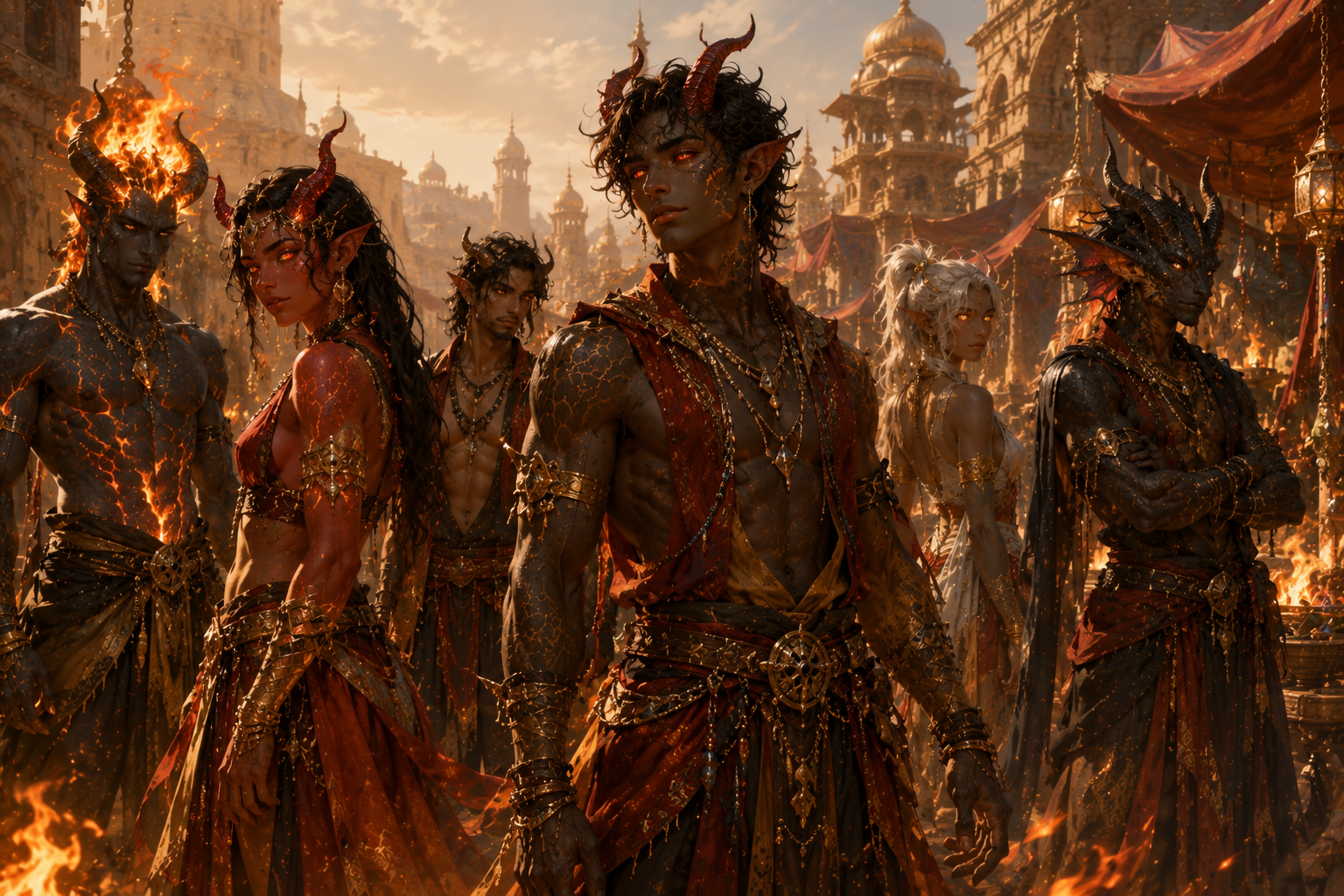
Ifrit appearance varies widely. Common features include pointed ears, red or mottled horns, ember-bright eyes, charcoal-toned scales, warm metallic skin, or hair that ripples as though moved by unseen heat.

Petra Ifrits often favor bright cloth, polished metal, jewelry, exposed arms, and clothing designed for extreme heat rather than heavy protection from the sun.

Some appear almost entirely human except for unusually warm skin or eyes that glow faintly in darkness. Others display unmistakable elemental traits from birth.

Restlessness & TravelThe Road Keeps the Fire Alive

A People Rarely Content to Stand Still

Many Petra Ifrits are drawn to movement, novelty, competition, and difficult goals. Caravan life suits them well because each journey offers new terrain, new people, and new problems to solve.

Settled Ifrits often channel the same energy into smithing, performance, trade, military service, exploration, or magic.

Their intensity can be mistaken for impatience, but experienced companions learn that an Ifrit who commits fully to a task can pursue it with remarkable persistence.

Forge CultureFire as Tool, Art, and Identity

Heat That Creates Instead of Destroys

Petra's smithies and foundries attract many Ifrits. Their resistance to fire makes furnace work less punishing, and some families build entire reputations around metalwork, glassmaking, ceramics, or heat-driven crafts.

The best Ifrit artisans do not treat fire as something to be worshiped blindly. They emphasize control: knowing when to feed a flame, when to starve it, and when too much heat ruins the work.

This philosophy also appears in personal conduct. Passion is respected, but uncontrolled destruction is often viewed as evidence that someone has never learned to master their own fire.

Petra HeritageGlass Wastes, Scars, and Caravan Roads

The Desert Favors the Fire-Touched

Petra is the principal homeland of the Ifrits in Abadonya, but their cultural heart is the Glass Wastes. Their oldest and strongest communities are found among its fused deserts, black-glass ridges, geothermal vents, hidden springs, and fire-scarred approaches. Smaller populations extend outward toward Zae'Halem, Venj Oasis, forge settlements, and Petra's caravan corridors.

Ifrit guides are valued on hot routes where ordinary travelers tire quickly, while Ifrit smiths and spellcasters are common wherever metal, glass, or flame matter to the local economy.

Some families deliberately settle near places others avoid—lava vents, scorched stone, hot springs, or old magical scars—because such environments feel more comfortable to them than mild country.

Faith & OutlookPassion with Purpose

The Flame Must Be Directed

Ifrit beliefs vary widely, but Petra traditions often connect fire with change, ambition, creation, destruction, and personal will.

Namir is a natural patron for many Ifrits through traditions of forge work, fire, endurance, and craft. Rashtala attracts those who view elemental flame primarily as a magical inheritance to be studied and mastered.

Ifrits may follow any alignment or deity. Their fire-touched nature does not determine morality.

Pathfinder 1e RulesRules Unchanged

Standard Pathfinder 1e Racial Traits

Ability Score Modifiers: Ifrits gain +2 Dexterity, +2 Charisma, and –2 Wisdom.

Type: Ifrits are outsiders with the native subtype.

Size: Ifrits are Medium creatures and have no bonuses or penalties due to size.

Base Speed: Ifrits have a base speed of 30 feet.

Languages: Ifrits begin play speaking Common and Ignan. Ifrits with high Intelligence scores can choose Aquan, Auran, Dwarven, Elven, Gnome, Halfling, and Terran as bonus languages.

Energy Resistance: Ifrits have fire resistance 5.

Spell-Like Ability: Ifrits can use burning hands once per day as a spell-like ability. Caster level equals the Ifrit's level; save DC 11 + Charisma modifier.

Fire Affinity: Ifrit sorcerers with the elemental (fire) bloodline treat their Charisma score as 2 points higher for all sorcerer spells and class abilities. Ifrit spellcasters with the Fire domain use their domain powers and spells at +1 caster level.

Darkvision: Ifrits have darkvision 60 feet.

Race Points: 6 RP.

These are the Pathfinder 1e racial mechanics used for Ifrit characters in Abadonya.

Alternate Racial TraitsPathfinder 1e Options

Selected Alternate Racial Traits

Brazen Flame: Melee attacks deal 1 point of fire damage. This replaces Energy Resistance and the standard spell-like ability.

Desert Mirage: Gain a +2 racial bonus on Stealth checks in desert environments and on saves to resist starvation and thirst. This replaces Fire Affinity.

Efreeti Magic: Use enlarge person or reduce person once per day as a spell-like ability. This replaces the standard spell-like ability.

Fire in the Blood: Gain fast healing 2 for 1 round whenever taking fire damage, up to 2 hit points per level per day. This replaces Fire Affinity.

Fire Insight: Fire-subtype creatures summoned by the Ifrit remain for 2 rounds longer than normal. This replaces Fire Affinity.

Forge-Hardened: Gain +2 on Craft (armor) and Craft (weapons) checks and on saves against fatigue and exhaustion. This replaces the standard spell-like ability.

Mostly Human: Count as both humanoid (human) and outsider (native), with an appearance close enough to pass as human. This alters type, subtype, and languages.

Wildfire Heart: Gain a +4 racial bonus on initiative checks. This replaces Energy Resistance.

These options use the normal Pathfinder 1e alternate racial trait replacement rules.

Elemental HeritagesPathfinder 1e Options

Alternate Elemental Heritages

Lavasoul: A magma-aspected Ifrit heritage with +2 Constitution, +2 Intelligence, and –2 Dexterity, replacing the default ability modifiers and associated elemental options according to the normal Pathfinder 1e heritage rules.

Sunsoul: A solar-aspected Ifrit heritage with +2 Strength, +2 Charisma, and –2 Wisdom, replacing the default ability modifiers and associated elemental options according to the normal Pathfinder 1e heritage rules.

In Abadonya, Lavasouls fit naturally near Petra's volcanic scars, while Sunsouls are often associated with open desert settlements and traditions built around endurance beneath the sun.

AdventurersFollowing the Next Flame

Challenge as Fuel

Ifrits become adventurers for excitement, power, exploration, rivalry, ambition, or the need to test themselves against something difficult.

Sorcerers, bards, rogues, fighters, alchemists, magi, and other agile or charismatic classes are common, though Ifrits can pursue any class.

A Petra Ifrit adventurer might cross the Glass Wastes to find a lost forge, follow rumors of a magical flame, escort a caravan through lethal heat, or prove that their family can master a challenge everyone else considers impossible.

Race IndexAbadonya Archive

Return to the Races of Abadonya index to browse other ancestries.