
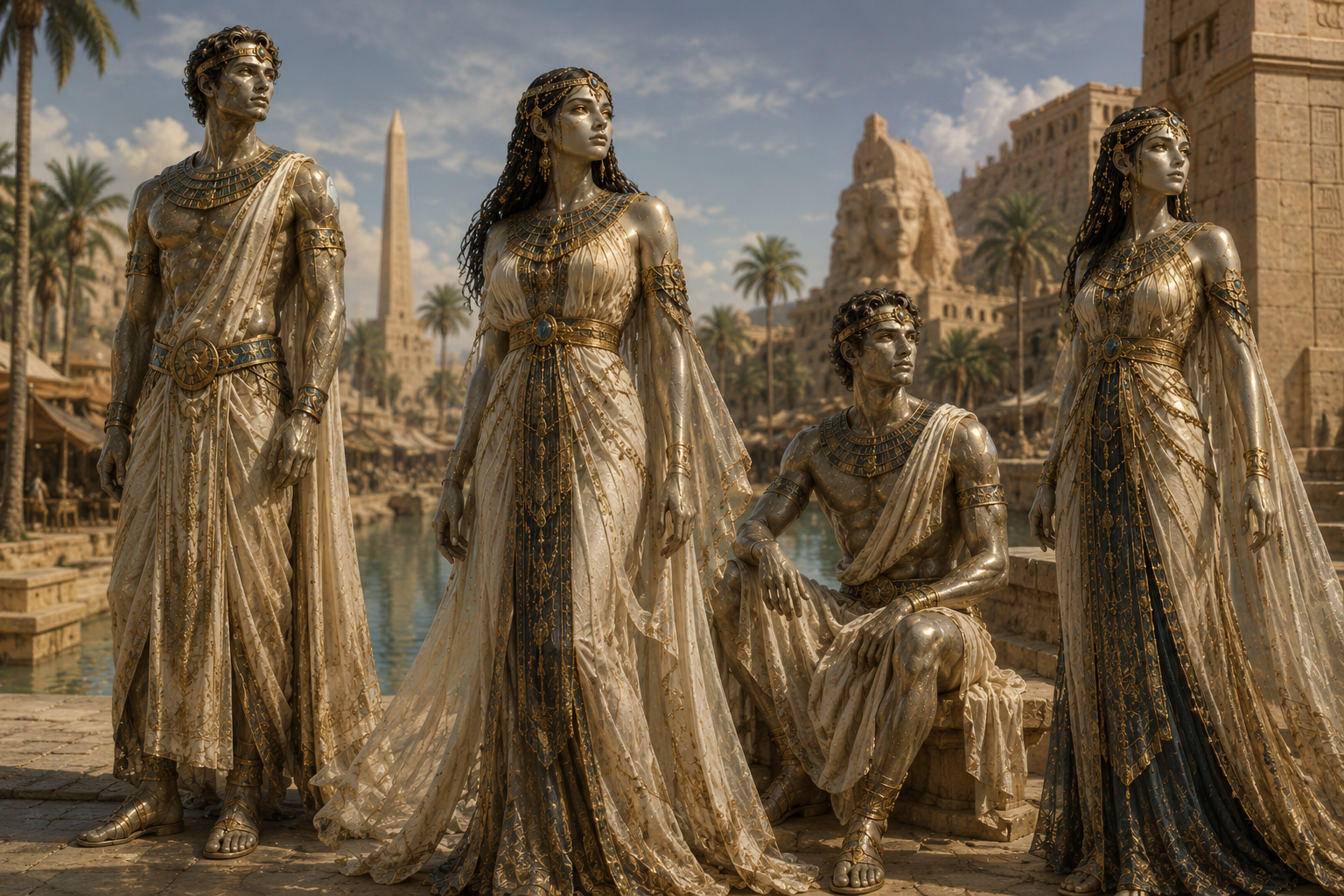
Shabti of Abadonya

Shabti are immortal soul-vessels most strongly associated with Petra's oldest funerary traditions. In the modern age, they can be found in Venj Oasis, where awakened Shabti have found a place among the city's travelers, scholars, merchants, and desert peoples. They resemble idealized mortals, but their memories often belong to rulers, priests, nobles, or powerful patrons for whom they were originally created. Many awakened within forgotten tombs, sealed necropolises, or hidden burial complexes, only to discover that the lives they remembered had never truly been theirs.

Shabti of Abadonya
Shabti in AbadonyaImmortal Echoes of Petra

Created for Lives That Were Not Their Own

Petra's oldest burial traditions tell of rulers and nobles so fearful of judgment after death that they commissioned perfect spiritual substitutes—beings intended to bear punishments, obligations, or consequences in their place.

Most such beings vanished into the mysteries of death and the planes beyond. A small number, however, escaped those destinies and eventually returned to mortal lands.

In the modern age, the most visible Shabti population in Petra can be found in Venj Oasis. Some arrive there after awakening in old tomb fields, forgotten caravan necropolises, buried temples, ruined courts, and other places where ancient funerary magic remains active. The oasis offers them a rare place to enter the living world, learn how Petra has changed, and begin building identities separate from the dead whose memories they carry.

AppearanceIdealized Mortal Forms

Perfect Faces with Uncertain Histories

Shabti usually resemble exceptionally idealized humans, often appearing as though sculpted according to an ancient culture's vision of physical perfection.

They commonly stand a little over six feet tall and possess flawless or highly symmetrical features. Some appear subtly artificial, with unusually smooth skin, metallic undertones, gold-flecked eyes, or features reminiscent of funerary statues.

Petra Shabti often favor clothing influenced by the era or culture preserved in their inherited memories, even when those fashions have been extinct for centuries.

False MemoriesLives Remembered but Never Lived

The Burden of Another Person's Past

A Shabti may awaken with memories of wealth, marriage, war, family, rulership, worship, betrayal, or death that feel completely authentic.

The difficulty is that those memories usually belonged to someone else. Discovering this can leave a Shabti uncertain about which instincts are truly personal and which were inherited from the mortal they were made to imitate.

Many spend decades deliberately accumulating new experiences so their own memories eventually outweigh the borrowed life carried within them.

This is one reason Shabti frequently become explorers, scholars, adventurers, and travelers.

The Tomb Traditions of PetraBurial Magic and Forgotten Courts

Where the Dead Feared Judgment

Shabti are most closely linked to the oldest periods of Petra's history, when powerful rulers and priesthoods devoted enormous resources to controlling what would happen after death.

Buried tomb complexes sometimes contain statues, sealed ritual chambers, identity tablets, ceremonial vessels, and inscriptions describing attempts to transfer judgment, guilt, memory, or obligation from one soul to another.

Most modern Petra priests consider these practices dangerous at best and deeply immoral at worst. Nonetheless, treasure hunters occasionally break seals that were meant to remain closed.

A newly awakened Shabti may emerge from such a site knowing the name of a ruler dead for a thousand years while knowing almost nothing about the modern world.

Many such newly awakened Shabti eventually make their way to Venj Oasis. Stories circulate among Petra's tomb-delvers that the oasis is one of the few places where a Shabti can arrive carrying an ancient name and still be judged by the life they choose to live now.

ImmortalityTime Without Old Age

A Life That Does Not Naturally End

Shabti do not age naturally and cannot die simply from the passage of years.

This makes them living witnesses to history if they survive long enough, but immortality does not make them invulnerable. Violence, disease, magic, planar dangers, and accidents can still kill them.

Some become patient scholars who think in decades rather than years. Others fear stagnation and deliberately seek new experiences to prevent eternity from becoming repetition.

Because returning a dead Shabti to life is unusually difficult, many become more cautious about death than outsiders expect from someone who never grows old.

Faith & OutlookJudgment, Identity, and the Soul

Who Is Responsible for a Borrowed Life?

Few peoples have a more complicated relationship with religion than the Shabti. Many were literally created because someone else feared divine judgment.

Some reject the beliefs of their creators completely. Others seek priests and scholars capable of helping them understand whether inherited guilt, memory, and obligation have any spiritual meaning.

In Abadonya, Marius attracts Shabti who seek answers about death, consequences, and contracts. Mandella appeals to those trying to separate truth from false memory, while Seraphim draws Shabti determined to define themselves through present actions rather than another person's past.

Shabti may follow any alignment or deity.

Pathfinder 1e RulesRules Unchanged

Standard Pathfinder 1e Racial Traits

Ability Score Modifiers: Shabti gain +2 Constitution and +2 Charisma.

Type: Shabti are outsiders with the native subtype.

Size: Shabti are Medium creatures and have no bonuses or penalties due to size.

Base Speed: Shabti have a base speed of 30 feet.

Languages: Shabti begin play speaking Common. Shabti with high Intelligence scores can choose any bonus languages except secret languages such as Druidic.

Darkvision: Shabti have darkvision 60 feet.

Immortal: Shabti do not age naturally and cannot die of old age. They remain in their original age category, though spells and effects that cause aging affect them normally.

Immune to Undeath: Shabti cannot become undead. Spells and abilities that would transform a Shabti into an undead creature have no effect.

Resist Level Drain: Shabti take no penalties from energy drain effects, though they can still be killed if they accumulate more negative levels than they have Hit Dice. After 24 hours, those negative levels are automatically removed without additional saving throws.

Past Life Knowledge: Shabti remember fragments of their past lives and treat all Knowledge skills as class skills.

Shattered Soul: Returning a dead Shabti to life with raise dead, resurrection, or similar magic requires a caster level check with a DC equal to 10 + the Shabti's Hit Dice. On a failed check, that caster cannot attempt to return the Shabti to life again for 24 hours.

Spell-Like Ability: Shabti can use suggestion once per day as a spell-like ability. Caster level equals the Shabti's class level.

Race Points: 13 RP.

These are the Pathfinder 1e racial mechanics used for Shabti characters in Abadonya.

Alternate Racial TraitsPathfinder 1e Options

Alternate Racial Traits

Blank Slate: Once per day as a free action, treat any skill as if you had ranks equal to half your character level for one skill check, with a minimum of 1 rank. This replaces Past Life Knowledge.

Facsimile: Appear nearly human and count as both humanoid (human) and outsider (native) for relevant effects. This replaces Immune to Undeath and alters the native subtype.

Pharaonic Will: Once per day as an immediate action after failing a save against a charm, compulsion, or fear effect, reroll the save with a +2 racial bonus. This replaces the spell-like ability.

Soul Sympathy: After being afflicted by temporary negative levels, force the creature that inflicted them to suffer the same cumulative penalties, hit point loss, and caster-level reduction while the link persists. This replaces Resist Level Drain.

These options use the normal Pathfinder 1e alternate racial trait replacement rules.

Favored Class OptionsPathfinder 1e Options

Favored Class Options

Bard: Add 1/2 to bardic knowledge.

Bloodrager: Add 1/4 to effective class level when determining bloodline power effects.

Investigator: Add 1/6 round to the duration of studied combat.

Medium: Add 1/5 to the bonus allies gain from shared séance.

Oracle: Add one psychic spell not on the cleric list to spells known; the spell must be at least 1 level below the highest spell level the oracle can cast.

Paladin: Add 1/2 level when determining smite evil's effect against incorporeal and ethereal creatures.

Ranger: Add 1/4 to one existing favored terrain bonus, to a maximum increase of +1 per favored terrain.

Shaman: Add one psychic spell not on the shaman list to spells known; the spell must be at least 1 level below the highest spell level the shaman can cast.

Skald: Add 1/2 to bardic knowledge.

Spiritualist: Add 1 foot to the limit of etheric tether.

These favored class options follow the standard Pathfinder 1e rules.

Shabti AdventurersReplacing False Memories with Real Ones

A Life Finally Their Own

Shabti adventurers are often motivated by identity rather than wealth. They travel because every genuine experience creates a memory that unquestionably belongs to them.

Bards, investigators, oracles, paladins, rangers, shamans, spiritualists, and other classes that engage with knowledge, souls, or exploration fit naturally, though Shabti can pursue any class.

A Petra Shabti might awaken beneath a forgotten temple, discover that the noble they remember was a tyrant, search for descendants of people appearing in false memories, or deliberately walk into a future no creator ever planned for them.

Race IndexAbadonya Archive

Return to the Races of Abadonya index to browse other ancestries.