
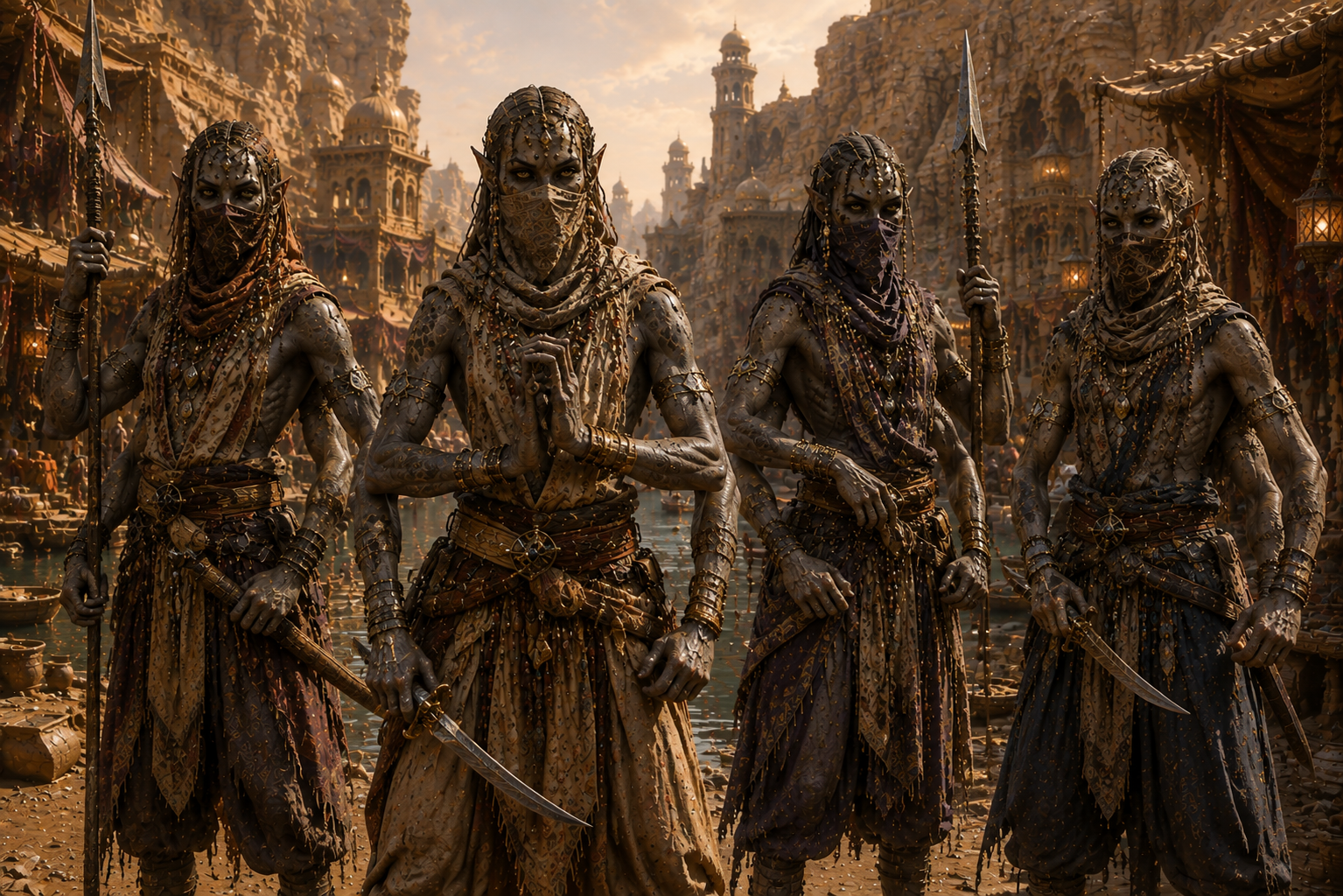
Tetrani of Abadonya

Tetrani are four-armed desert people who historically had no permanent homeland of their own. For generations their clans wandered Petra's deserts, canyons, and caravan routes, carrying their traditions with them rather than binding them to a single city or territory. That changed when the Queen of Zae'Halem took in many of the wandering tribes, offering them protection, food, water, and a place within her city. In return, many Tetrani entered her service and now form an important part of the Queen's personal protection and security forces.

Tetrani of Abadonya
Tetrani in AbadonyaWandering Tribes of Petra

A People Without a Homeland

For most of their history, the Tetrani possessed no city, kingdom, or settled homeland. Their clans moved across Petra in long seasonal circuits, following water, trade, grazing, pilgrimage routes, and old agreements between tribes.

Some clans crossed the same stretches of desert for generations without ever claiming the land beneath them. To the Tetrani, identity belonged to the clan, its stories, its oaths, and the people traveling beside you—not to walls or borders.

This wandering existence made them exceptional desert travelers, but it also left many tribes vulnerable to drought, raiders, political pressure, and the disappearance of older caravan routes.

AppearanceFour Arms, Lean Frames, and Desert Veils

A Form Unlike Any Other People of Petra

Tetrani are tall, lean humanoids with four fully functional arms arranged in two pairs. Their bodies are built for agility and endurance rather than heavy bulk.

Skin coloration commonly ranges through gray, brown-gray, sandstone, ash, and other muted desert tones. Their eyes are often very dark, giving the face a calm and unreadable appearance.

Traditional clothing uses layered desert fabrics designed to protect against sun, wind, and blowing sand. Many Tetrani keep the lower portion of the face covered in public as a sign of restraint, privacy, and respect.

Jewelry, woven patterns, beadwork, and weapon fittings frequently identify clan, family, pilgrimage history, or personal achievement.

The Four HandsCoordination as Everyday Life

More Than a Combat Advantage

Tetrani culture developed around four-handed coordination long before outsiders focused on its military advantages.

A craftsperson can stabilize a piece with one pair of hands while working it with another. A climber can maintain multiple points of contact. A traveler can manage tools, reins, weapons, or supplies simultaneously.

Children spend years learning disciplined coordination. Dropping objects, crossing one's own motions, or relying too heavily on one pair of arms is treated as a normal part of youth rather than incompetence.

In warfare, four arms offer enormous versatility, but Tetrani combat traditions emphasize control and positioning rather than simply carrying as many weapons as possible.

Clan TraditionsMemory Carried Across the Sand

History Belongs to the Living

Tetrani society is organized around extended clans whose traditions are preserved through oral history, woven records, inherited weapons, and formal storytelling.

Elders are respected because they remember routes, agreements, feuds, water rights, burial grounds, and the histories behind long-standing alliances.

A Tetrani is expected to know not only personal ancestry but the obligations attached to it. Old promises can remain socially important generations after the people who made them are gone.

This emphasis on continuity gives Tetrani communities a reputation for being formal with strangers but deeply loyal once a relationship is recognized.

Since the settlement of many tribes in Zae'Halem, Tetrani clan identity has become even more important. Settled families preserve the names of old routes, vanished camps, and desert wells so that city life does not erase the memory of who they were before the Queen's invitation.

The Tempering JourneyAdulthood Through Experience

Leave, Learn, and Return

Many Tetrani clans still mark adulthood with a period of independent travel known as the Tempering Journey, a tradition inherited directly from the centuries when every tribe lived on the move.

A young Tetrani leaves familiar clan territory and spends months or sometimes a full year traveling, working, studying, trading, serving as a guard, or exploring unfamiliar lands.

The purpose is not exile. The traveler is expected to return with something the clan did not possess before: useful knowledge, a new skill, a map, a story, an alliance, a rare tool, or hard-earned wisdom.

Some discover during the journey that their path lies elsewhere and become permanent adventurers, merchants, scholars, or wanderers.

Among settled clans in Zae'Halem, service in the Queen's guard, desert patrols, or royal escort companies is now one of the most respected ways to complete this journey.

Zae'Halem and the TetraniThe Queen's Offer

A Home Offered by the Queen

The greatest change in Tetrani history came when the Queen of Zae'Halem opened her city to many wandering tribes. She offered secure water, food, shelter, legal protection, and a permanent place inside a city that had previously regarded many desert clans only as temporary visitors.

Many accepted. Families that had spent generations moving between camps established permanent quarters, workshops, training yards, and clan halls within and around the city.

The agreement was not purely charitable. The Queen recognized the value of Tetrani endurance, perception, mobility, and four-armed combat discipline. In exchange for sanctuary and status, many Tetrani entered her service.

Today, Tetrani guards are a visible and respected part of the Queen's protection. They serve as palace guards, escorts, desert scouts, gate wardens, caravan outriders, and trusted protectors assigned to individuals and locations important to the crown.

Not every tribe accepted the Queen's offer. Some clans continue the old wandering life and regard settled Tetrani with caution, believing that safety inside walls always creates obligations to whoever owns the walls.

Faith & OutlookDiscipline Beneath an Unforgiving Sun

Endurance Without Waste

Tetrani traditions often treat discipline as a form of respect: respect for one's companions, for limited supplies, and for a desert that punishes careless decisions.

Mandella attracts Tetrani who value wisdom, memory, and the preservation of knowledge gathered through travel. Trentula is respected by those who understand the desert as a complete living ecosystem rather than an empty wasteland.

Namir is also honored among craftspeople and warriors who value practiced skill, durable tools, and endurance.

Tetrani may follow any alignment or deity.

Pathfinder 1e RulesRules Unchanged

Standard Pathfinder 1e Racial Traits

Ability Score Modifiers: Tetrani gain +2 Dexterity and +2 Wisdom.

Type: Tetrani are humanoids with the Tetrani subtype.

Size: Tetrani are Medium creatures and have no bonuses or penalties due to size.

Base Speed: Tetrani have a base speed of 30 feet.

Languages: Tetrani begin play speaking Common and Tetrani. Tetrani with high Intelligence scores can choose Dwarven, Draconic, Gnoll, Orc, and Sphinx as bonus languages.

Defensive Training, Greater: Tetrani gain a +2 dodge bonus to Armor Class.

Desert Runner: Tetrani gain a +4 racial bonus on Constitution checks and Fortitude saves to avoid fatigue, exhaustion, and other harmful effects from running, forced marches, starvation, thirst, and hot or cold environments.

Stalker: Perception and Stealth are class skills for Tetrani.

Jumper: Tetrani are always considered to have a running start when attempting Acrobatics checks to jump.

Desert Stride: Tetrani move through nonmagical difficult terrain in desert environments at normal speed.

Multi-Armed: A Tetrani has four arms. One hand is considered the primary hand and the remaining hands are off hands. The Tetrani can use any of these hands for other purposes that require free hands.

Race Points: 20 RP.

These are the Pathfinder 1e racial mechanics used for Tetrani characters in Abadonya.

Alternate Racial TraitPathfinder 1e Option

Alternate Racial Trait

Stealthy: Some Tetrani are trained to conceal themselves and their movements from outsiders. They gain a +2 racial bonus on Stealth checks, and Stealth is always a class skill for them. This replaces Jumper and Stalker.

This option uses the normal Pathfinder 1e alternate racial trait replacement rules.

Tetrani AdventurersWhen the Tempering Journey Never Ends

Travel as Education

Tetrani adventurers often begin as young adults undertaking a traditional journey and discover that the wider world offers more knowledge than they expected.

Rangers, monks, fighters, rogues, clerics, and other agile or perceptive classes are common, though Tetrani can pursue any class.

Their four arms can support unusual combat styles and equipment combinations, while Desert Runner and Desert Stride make them exceptionally capable explorers in Petra.

A Tetrani adventurer might seek forgotten caravan routes, recover an ancestral weapon, fulfill an old clan promise, or gather knowledge valuable enough to justify years away from home.

Some Tetrani adventurers are former royal guards from Zae'Halem, temporarily released from service, assigned to protect an important traveler, or sent beyond Petra on the Queen's business.

Race IndexAbadonya Archive

Return to the Races of Abadonya index to browse other ancestries.